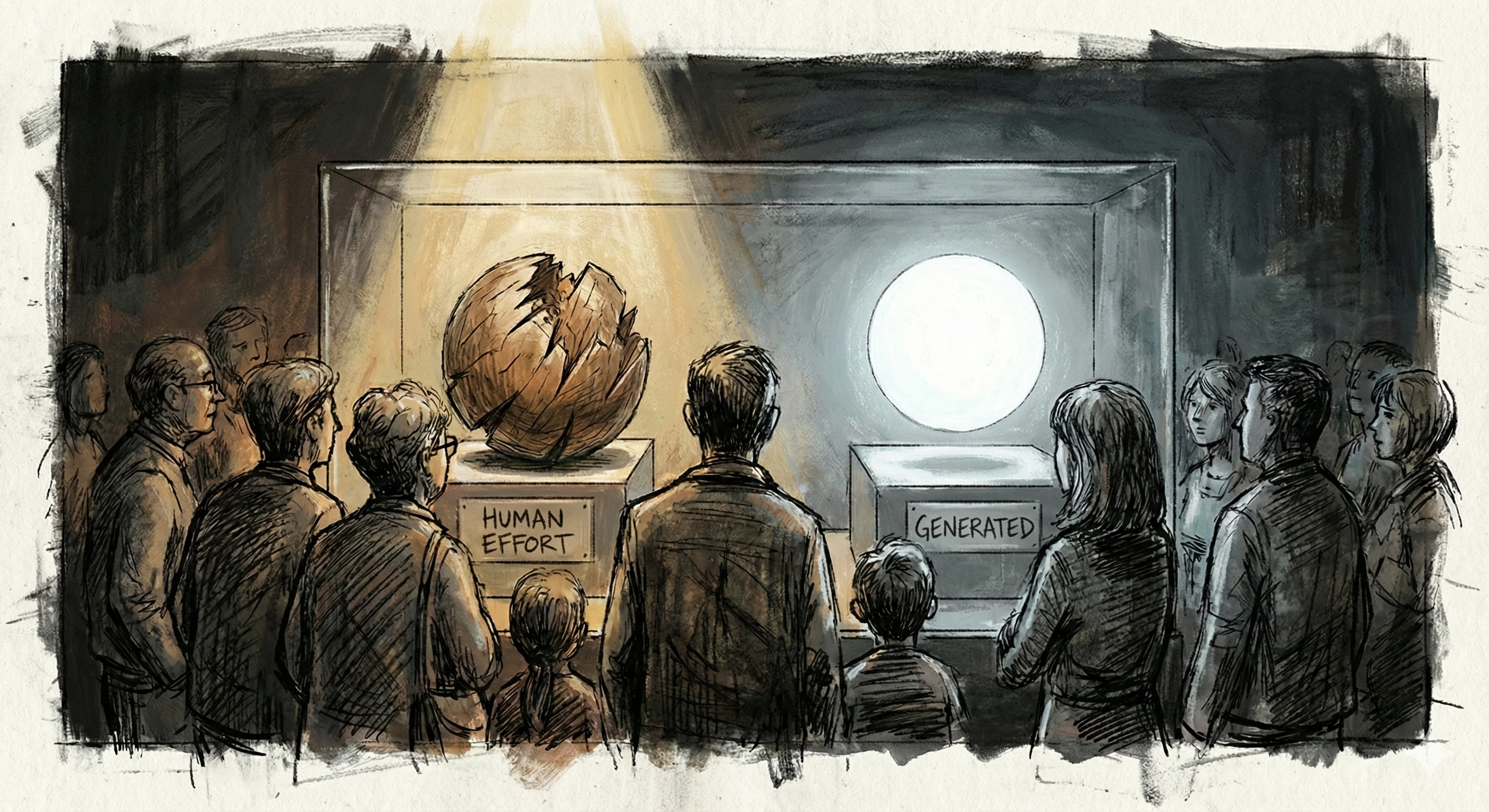
I like to use analogies to explain complex things. Analogies are great for this because they connect the novel to what we already understand, but their purpose isn't to be a perfect explanation. They are architecture of thinking. When you need to cross a river, you build a raft. The raft is useful because it gets you across. Once you're across, you can toss it away. The crossing is what matters.
This analogy is a raft. Use it, then discard it when it has fulfilled its use. Yes, I just used an analogy to explain my analogy.
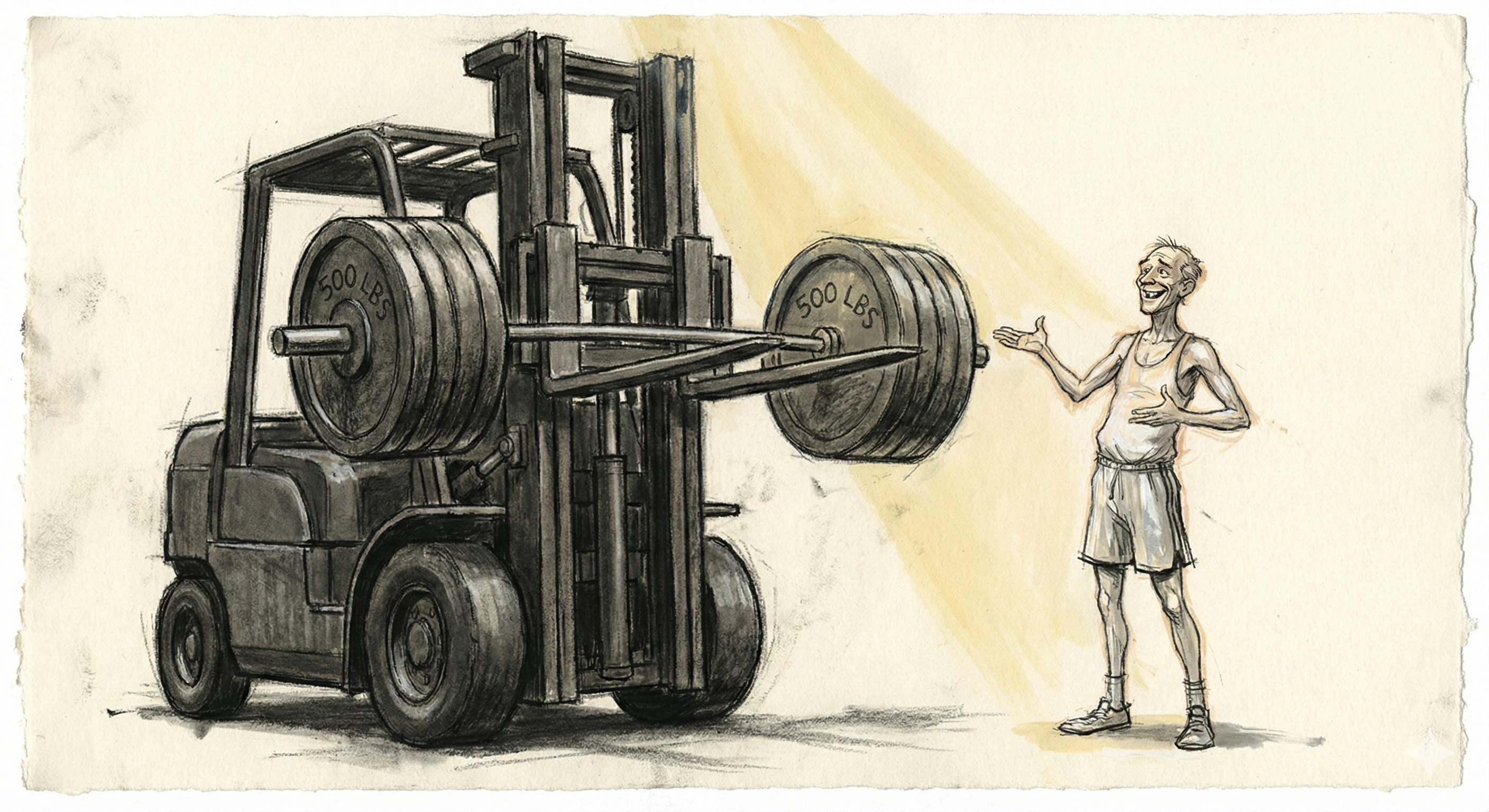
Ok, think of AI as a cognitive multiplier. If I wanted stronger hamstrings, I might deadlift 100 pounds and slowly add weight. However, if you saw me banging out 500 pound deadlifts with a forklift, you wouldn't be impressed. The point isn't to move the weight. The point is to get stronger.
We'll return to this.
Because my students taking mock exams gave me a bit of a reprieve, and I knew they'd soon be back with relatively little time before the real deal, I thought I'd write a quick guideline for using AI effectively during revision.
That's not what happened. This piece grew into something more philosophical. It examines who we're becoming as thinkers and learners while cognitive augmentation becomes ubiquitous. The main point I'll get at is sequence plays a large role in determining whether AI helps or hinders your learning. What matters is when and how you bring your confusion, partial understanding, genuine questions to the interaction. If you'd like to skip the philosophical and academic base for my AI learning guidelines, you should probably skip to [link to practical guide for AI]
The Multiplier
Now let's return to the analogy briefly. Think of AI as a multiplier applied to whatever capacity you bring. Someone lifting 100 pounds, multiplied by 10, produces 1,000 pounds of output. Someone lifting 500 pounds produces 5,000 pounds.
The catch: getting to 10x is a skill. AI can produce vapid content if you bring vapid thinking. The multiplier might only be 2x if you haven't developed judgment. It can backfire entirely. Right now, that 1,000 pound output generated from minimal foundational strength looks pretty good. The tempting calculation: "Why bother with slow, difficult work when I can simply multiply whatever modest capacity I currently possess?"
What's coming is that everyone has access to AI. The multiplier becomes table stakes. Once everyone operates with the same multiplicative tools, what differentiates individuals ceases to be access to the multiplier. The quality and depth of what gets brought to be multiplied becomes the differentiating factor. And this particularly matters because there's a measurable negative correlation between AI usage frequency and critical thinking scores (Gerlich, 2025). So if you let the cognitive fork lift deadlift for you, you are losing thinking capacity. Interestingly, students with stronger foundational knowledge were immune to this effect because they were using AI as a second opinion, not an oracle. Their foundations allowed them to make effective evaluative decisions on the outputs.
The weightlifting analogy reveals its limitations here. Competitive advantage isn't ultimately what's at stake. Something deeper concerns not just what gets produced but who gets produced in the process of producing it.
The Cost of Outsourcing Cognition
One common worry about AI centers on outputs: will AI teach something false?
In my opinion, that's not where the most significant cost lives. The real cost concerns what happens to the person doing the producing. Outsourcing cognitive work shapes the self that emerges from the process.
Thus, perhaps a more useful framing: the person using AI is the prompt. Not merely the composer of prompts but the entirety of what gets brought to the interaction. This includes questions emerging from genuine confusion, half-formed thoughts developing through sustained attention, and connections noticed between disparate domains but not yet articulated.
The richness of prompts reflects the richness of the self doing the prompting. A self built through struggle has capacity to produce prompts that give AI something valuable to work with. A thin self produces thin prompts that result in generic outputs.
The work isn't simply a means to produce an essay. The thinking, the struggling, the getting stuck and coming back all matter.
The work simultaneously produces a self that can wield those artifacts with understanding. A person who can defend them when challenged, extend them when circumstances demand it, connect them to situations that weren't anticipated.
AI can generate the essay with remarkable fluency. What it cannot generate is the person who could defend that essay, extend its arguments, or recover when someone challenges a foundational assumption.
Educational theorist David Perkins calls this "flexible performance." Understanding gets demonstrated through explaining concepts multiple ways, applying to novel contexts, extending arguments beyond their initial scope.
When the thinking gets outsourced early, before genuine understanding has been constructed, what remains is the artifact itself- the noun. The capacity to perform flexibly never gets built because the work that would have built it got skipped. You get the noun but not the verb.
MIT researchers found something striking about this phenomenon (Kosmyna et al., 2025). Over 80% of students using ChatGPT couldn't recall a single sentence from essays they'd written minutes earlier. The text never entered their memory because the effort of generation was bypassed. The artifact exists. The understanding does not.
Memory Retention: AI-Assisted vs Independent Writing
Students using ChatGPT couldn't recall their own essays
The Artifact Without Understanding
Over 80% of students using ChatGPT couldn't recall a single sentence from essays they'd "written" minutes earlier. The text never entered their memory because the effort of generation was bypassed. You get the noun but not the verb.
Source: MIT Media Lab (Kosmyna et al., 2025)
The Cognitive Tax
The response might reasonably run: "That noun is real and can still be handed in. The grade can still be received."
Maybe. There remains a cost that operates beneath conscious awareness.
We've all experienced feeling judged. That feeling when we know we're being evaluated and we're not sure if we can back up what we've said. Research by psychologist Claude Steele on stereotype threat shows this measurably reduces working memory. Part of our minds get hijacked by self-monitoring. We have less mental capacity available for actual work.
In the Moment: In class discussion, part of the brain scans constantly for signs of suspicion. Did they notice? Are they about to ask a question we can't answer? Another part manages how we're presenting ourselves, minimizing risk rather than genuinely engaging. What remains for thinking about the material is substantially diminished.
Over Time, We Make Ourselves Smaller: We start structuring our lives to avoid situations where insufficient foundation might become visible. We stay surface-level. We deflect conversations when they move toward territory where understanding runs thin. We don't ask questions when genuinely confused. We don't go to office hours. We hedge everything to avoid statements that could be challenged.
The Vicious Cycle: When we structure our lives to avoid situations that would test understanding, we cut ourselves off from the very experiences that would build what's missing. Outsource the thinking. Discover we can't back up the output. Avoid future challenges. Never encounter experiences that would build foundation. Keep outsourcing because foundation never develops.
Recent research from MIT's Media Lab reveals something crucial: "Starting passive means staying passive." Students who engaged in independent thinking before turning to AI maintained neural engagement comparable to those who avoided AI entirely. Students who began with AI consultation remained cognitively passive even after switching to supposedly independent work later.
The sequence matters fundamentally.
MIT's four-session longitudinal study (Kosmyna et al., 2025) provided physiological evidence for this. Students who spent three sessions writing independently, then switched to AI assistance, showed a network-wide spike in brain connectivity. The existing neural pathways strengthened through independent work could integrate AI as augmentation. Conversely, students who relied on AI first showed persistent under-engagement in those same networks. They even reused AI-specific vocabulary from previous sessions, suggesting shallow processing without genuine integration.
Sequence Matters: Brain-First vs AI-First Learning
Starting passive means staying passive
Brain-First Pathway
Existing neural pathways integrate AI as augmentation
AI-First Pathway
Neural pathways never developed. AI vocabulary recycled without understanding. Becomes dependency.
"Starting passive means staying passive. The sequence isn't reversible."
Source: MIT Media Lab Longitudinal Study (Kosmyna et al., 2025)
The Phase That Can't Be Substituted
There is a phase in learning that AI cannot substitute for. This phase involves the messy, recursive process of testing ideas that turn out inadequate. Getting stuck. Giving up temporarily. Coming back after time away reveals new angles. Ultimately, we discover through this discomfort that figuring things out is actually possible.
This phase leaves something behind. Writer Jack Cheng in his excellent article What Becomes Valuable When AI Makes Creative Work Easy quotes James Wood, calling it "this-ness," roughly meaning "the specificity of your lived experience." The struggle matters in and of itself. Time spent in sustained attention to problems without obvious solutions matters.
The work produces a version of you who has been through something. A you who has inhabited that conceptual territory through sustained cognitive effort rather than someone who received a map generated by something else's journey.
This required phase isn't a one-time gate. Even experts need to keep returning to unassisted thinking to maintain understanding rather than allowing the line between what they actually know versus what AI can do to blur.
An uncomfortable recognition I have arrived at is that there's no rule that specifies when "enough" original work has been done before AI use transitions from outsourcing to legitimate collaboration that amplifies ones own learning.
No clean signal reliably indicates "sufficient foundation has been built."
Part of what I'm asking for if you want to use AI to learn is accepting discomfort rather than seeking optimization. Using AI effectively means willingness to remain in struggle a bit longer than feels necessary.
David Epstein, in Range: Why Generalists Triumph in a Specialized World, hits the nail on the head: "For learning that is both durable and flexible, 'fast and easy is precisely the problem.' We tend to forget what comes easy, but hold on to what challenged us."
What gets acquired easily gets forgotten easily. Easy to learn, easy to forget.
The Paradox: AI Can Help You Learn
You could be forgiven for thinking this entire word vomit condemns AI use for learning, yet learning genuinely happens through engagement with AI. My understanding has improved. New perspectives have emerged as I had Gemini ask me 34 socratic questions about my views on AI in learning.
A 2025 randomized controlled trial in K-12 classrooms confirmed something important about how AI design shapes learning outcomes. Students using Socratic AI (programmed to refuse direct answers and ask probing questions instead) showed significantly greater learning gains than students using standard AI tools. Crucially, they reported higher confidence in their understanding because it came from their own thinking, not from accepting generated content. This is essential to avoid the cycle of making oneself smaller.
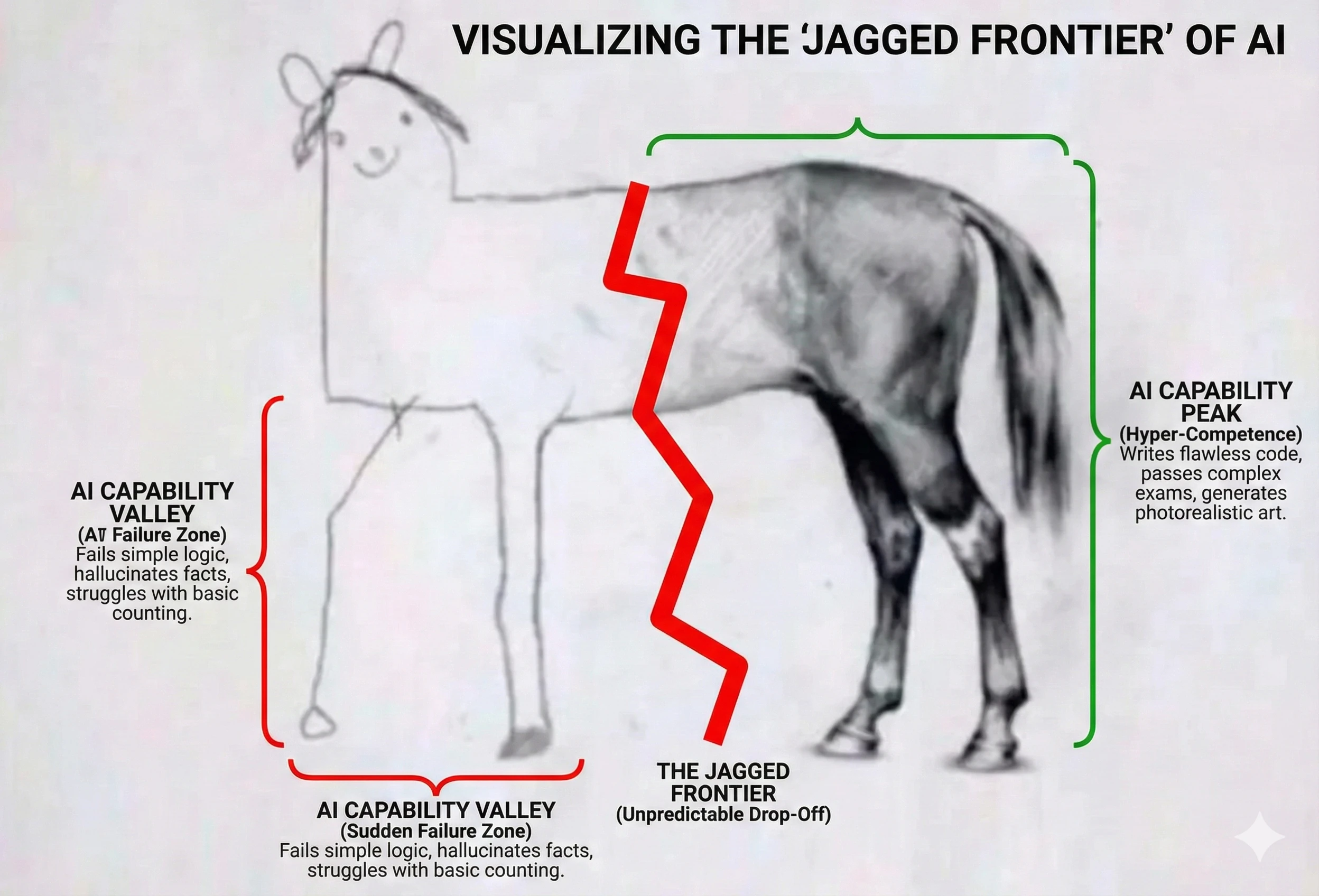
Part of what makes this paradox possible is what researchers call the "jagged frontier" of AI capabilities. AI doesn't improve uniformly across all tasks—it can excel at complex reasoning while stumbling on seemingly simple problems, or vice versa. This uneven landscape of capabilities means that if a student shows up without doing the thinking first, there is a risk they don't realise where or when the LLM has crossed that jagged edge.
The crucial recognition: sequence determines whether AI functions as a learning tool or a thinking-replacement tool.
There exists a meaningful difference:
- Passive AI Consultation: "give me a good example from art for my ToK essay on whether we only understand a thing to the extent we understand its context" submitted without prior thinking, treating AI as replacement for cognitive work
- Active AI Collaboration: Thinking first about what a good example might involve, developing initial frameworks however incomplete to evaluate, then using AI to challenge those frameworks and identify blindspots.
Consider the example of learning to code. Copying working code from Stack Overflow produces a program that runs. Learning the underlying logic and syntax patterns instead builds transferable understanding that applies across multiple problems. One pattern creates dependency on finding this specific solution already written. The other creates capacity that generalizes.
Performance with and without AI assistance over time
Passive users show temporary boost but lose skills without AI support
AI used passively, before genuine thinking has occurred, creates dependency. AI used actively, after struggling with problems and bringing partial understanding, builds capacity that persists.
This dynamic isn't new. GPS weakened spatial memory. Google reduced the felt need to retain information. AI now targets higher-order thinking capacities that remained protected: the ability to think flexibly, generate novel solutions, connect ideas across domains.
What I Want You To Feel
I started wanting to write "8 tips for using AI properly." I still want to do that. First I needed to grapple with an uncomfortable question:
Have I been skipping the phase that can't be skipped, outsourcing the work that builds the self, treating AI as replacement rather than extension?
Consider honestly the moments where the immediate move was straight to AI. Where the uncomfortable part of thinking first got bypassed for efficiency.
The pressure is real. Six subjects, plus ToK. Clustered deadlines. The entirely reasonable desire for more efficient ways to manage overwhelming demands.
Here's what matters: the pressure that AI seems to offer escape from is building something in you. Capacities that won't exist if the pressure gets systematically avoided.
That discomfort you feel when stuck on a problem, when understanding hasn't emerged, when you're not sure how to proceed—that's the "this-ness" being built through lived experience.
There's a phase in every learning process that can't be skipped without cost. A period of struggle that must be inhabited rather than bypassed.
When that phase gets skipped, the cost will be felt. Perhaps not immediately in grades. Eventually in the self that's been constructed or failed to be constructed.
Though the educational system primarily evaluates outputs, no one is just producing outputs. Everyone is simultaneously producing themselves. Constructing the self that will navigate contexts where thinking flexibly matters long after grades are forgotten.
Five years from now, everyone will have access to AI multipliers that make current tools look primitive. The question that will differentiate people: what foundation has been built that's worth multiplying, what capacity exists independently of the tools, who have you become through the work of becoming?