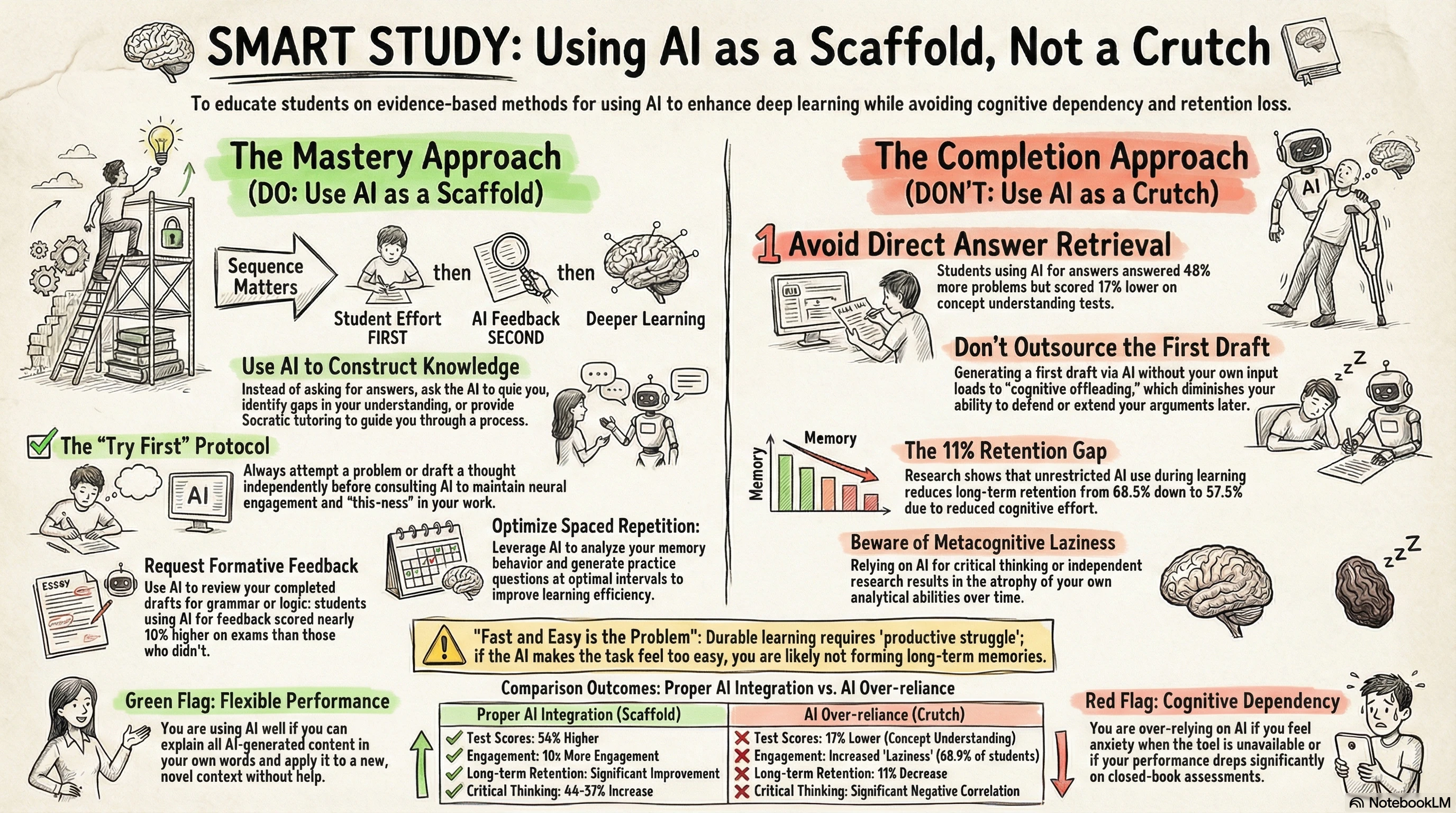
In my other post I said that I set out to create some guidelines for how to use AI better. Here I fulfill that promise. AI can be a fantastic tool for helping you learn and developing your understanding but there are some key things to avoid and some general rules to follow to get the most out of it.
Here is the approach I tend to follow along with some examples of how I do that I took from the last blog entry I wrote.
If you're looking for some prompt templates to help you get started, you can find them at the end of this post.
1. The "Try First" Protocol: Build Your Foundation
Before you open ChatGPT, have something brewing.
Not expertise. Not a fully-formed thesis. Just something you've been turning over in your mind. A question that won't let go, a half-formed idea, a confusion you can't quite articulate yet.
Why this matters: MIT research found that students who started with ChatGPT showed the lowest brain engagement and consistently underperformed across neural, linguistic, and behavioral measures (Kosmyna et al., 2025). When you start without your own thinking, your brain never fully engages.
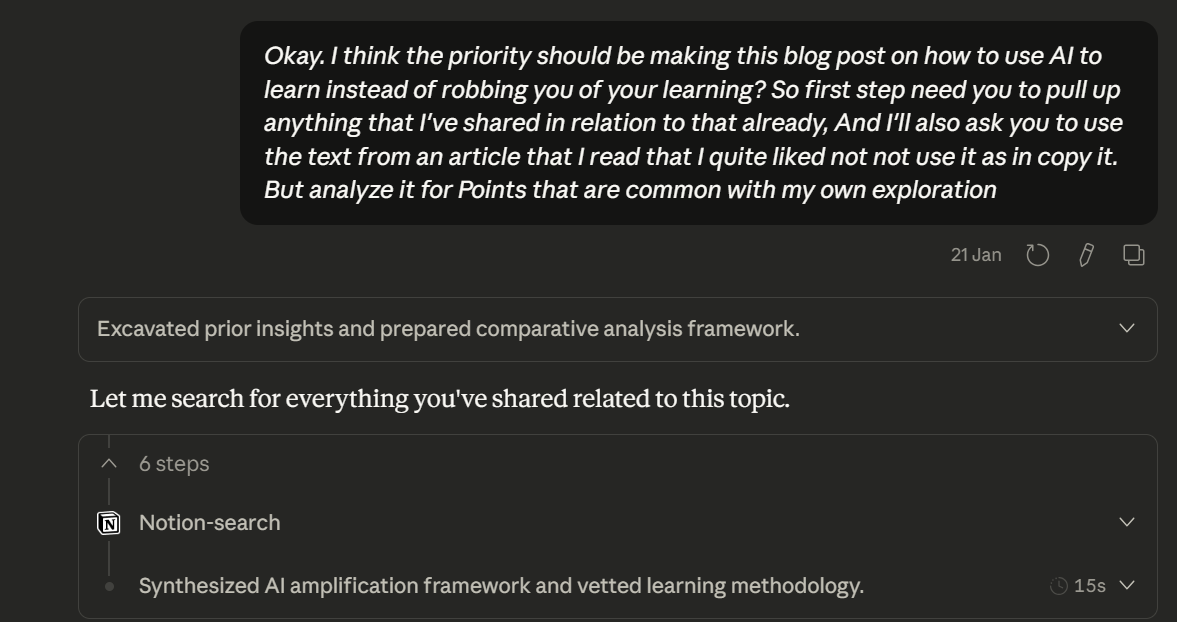
How I do this: I capture half-formed thoughts using Claude connected to a Notion database through MCP. I use voice input while walking my dog. The ideas get recorded automatically.
I'm not filtering for "good ideas." I'm capturing anything that sticks: questions, confusions, observations, half-connections. I'm just building a collection of things I've thought about first.
Then I have other Notion databases where Claude asks me questions to develop these fragments. This creates a collection of thinking I've already done.
Example: Before my first blog post, I'd been mulling over AI as a "cognitive amplifier" for weeks. I had fragments (the weightlifting analogy, something about a "cognitive tax," a demo I wanted to try). None of it was organized. It was mine. That gave the conversation something to work with.
In practice:
- Stew on the problem before searching for solutions
- Capture half-formed thoughts (voice, notebook, database)
- Have conversations with AI to develop fragments
- Build a collection of things you've thought about first
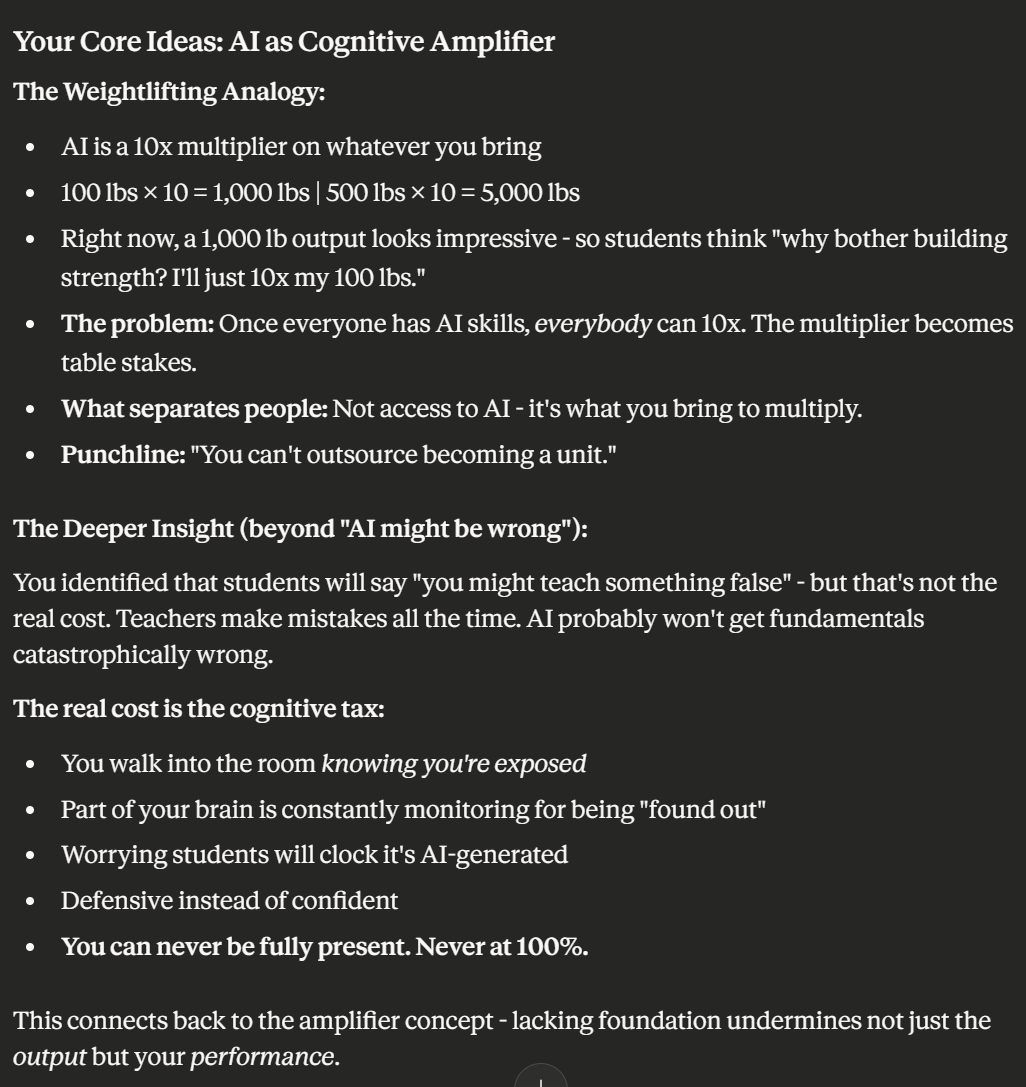
2. Use AI to Construct Knowledge, Not Retrieve Answers
Okay so you've collected some half-formed ideas, some initial tentative thinking. Now construct something with that. Turn it into bullet points, make an outline, do a chart of what you know, what you don't know, what you recognise at this point. Use any metacognitive thinking routines that are effective for you in constructing knowledge from your initial brain dump. Attempt the problem; get stuck in.
Research on mastery learning found that higher-level learning occurs when students use AI to construct knowledge rather than retrieve answers (Taylor & Francis, 2025).
The order matters. Start with AI, you're retrieving. Start with your own thinking, you're constructing.
How I do this: Once I have a half-formed idea, I turn it into a bullet-point outline. Not polished. Just structured enough to show what I'm thinking and where I'm stuck. Beneath each bullet point, I write the start of the paragraph or idea — as far as I can get until I'm not sure — and then I move on to the next bullet point.
That rough draft is what I bring to AI for feedback. Not a blank page but a structured draft.
Example: When I started developing the blog post, I gave AI my draft framework (bullet points, phases, constraints). AI's job was to pressure-test what I'd brought, not create it for me.
The conversation worked because I had a foundation.
In practice:
- Draft before you prompt
- Turn half-formed ideas into bullet-point outlines
- Bring structure, even if messy
- Give AI something to react to
3. Request Formative Feedback: AI as Challenger, Not Answerer
Once AI enters, don't ask it for answers. Ask it to question you.
The research distinguishes between "mastery approach" (using AI to construct understanding) and "completion approach" (using AI to get things done). The mastery approach produces learning. The completion approach produces dependency.
An Australian university study found students using AI for formative feedback scored 9.8% higher on final exams compared to peers relying on peer review alone (Mollick, 2024). They used AI to challenge their thinking, not replace it.
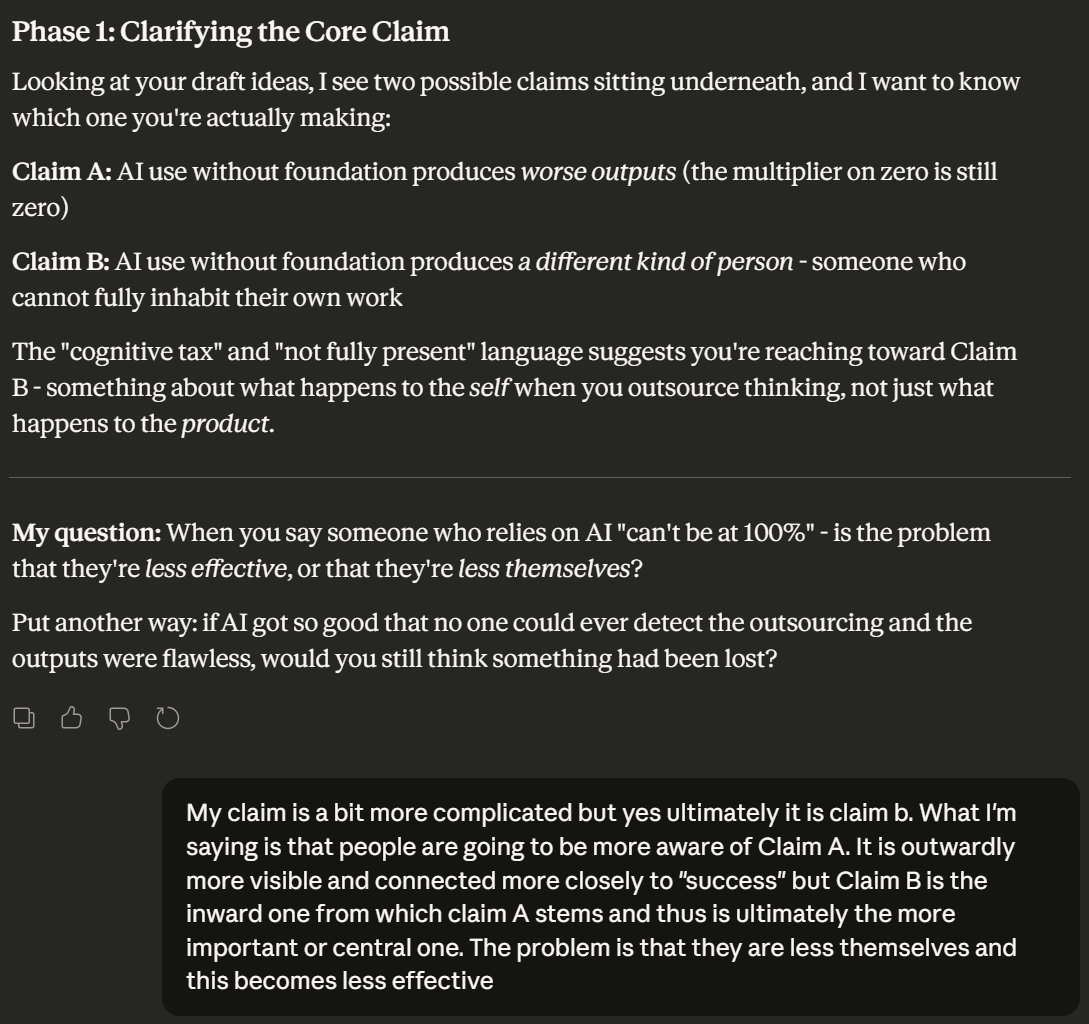
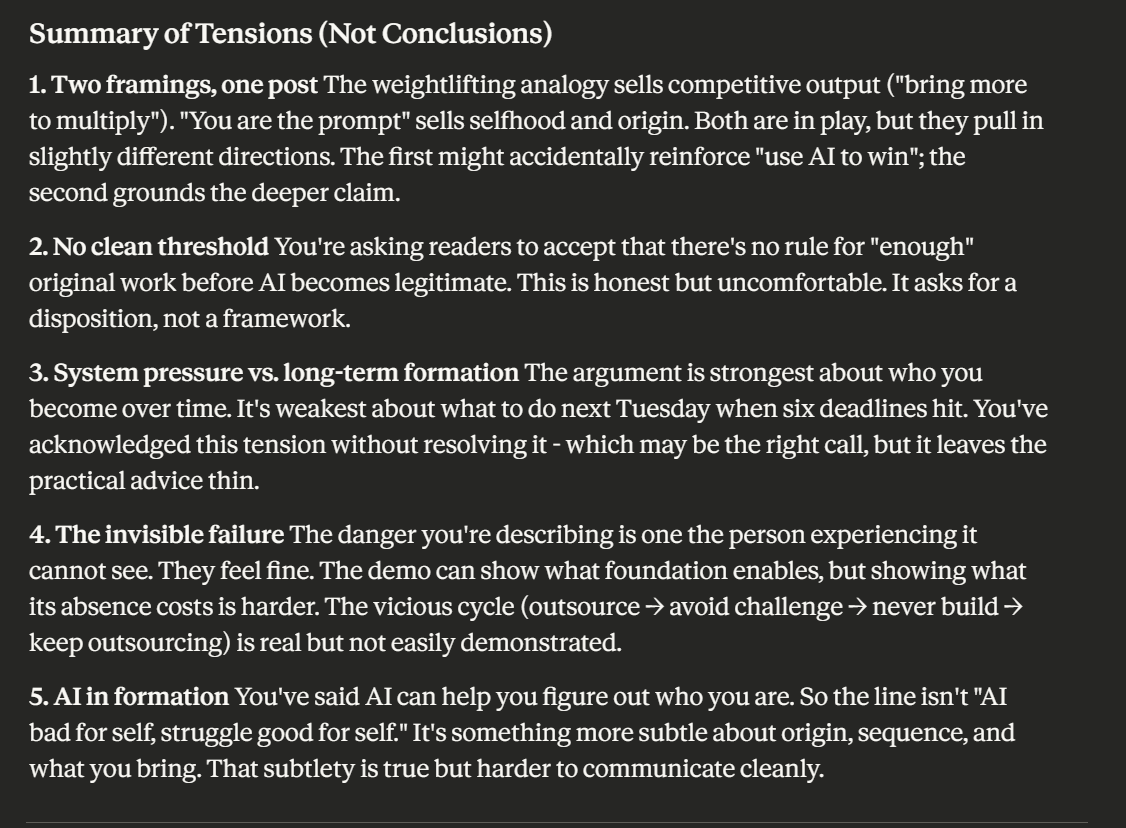
How I do this: I use prompting based on "Recursive Language Models" by Kraska, Khattab, and Zhang. This gets Claude to dig into my work through Socratic questioning. The screenshot shows 1 of about 30 questions it asked me. It took me somewhere in the area of 45 minutes to untangle my core argument and in fact this is precisely where I realised that I was trying to write 2 things: a guideline and the underpinning principles that the guideline emerges from.
Practically: ask AI to interrogate your thinking, find gaps, surface what you haven't considered.
Example: Over 20-30 questions, AI pushed on every part of my argument. What's the mechanism? Where does the metaphor break? What would a skeptic say? I had to answer. AI made me discover my argument by defending and extending what I'd brought.
That's formative feedback. Not "here's the answer" but "here's what you haven't thought through yet."
In practice:
- "What's weak about this argument?"
- "What am I not considering?"
- "Challenge this assumption"
- "Where does this logic break?"
4. Critically Evaluate: Avoid Cognitive Offloading
Don't accept what AI gives you. Engage with it.
Without foundation, everything AI produces looks plausible. With foundation, you can catch what's missing, push back on what's wrong, recognize when AI misses your purpose.
A systematic literature review found regular AI use was associated with decline in students' cognitive abilities, with 68.9% exhibiting increased laziness and 27.7% experiencing degradation in decision-making (Springer, 2024). The mechanism? Cognitive offloading. They outsource the thinking. The capacity atrophies.
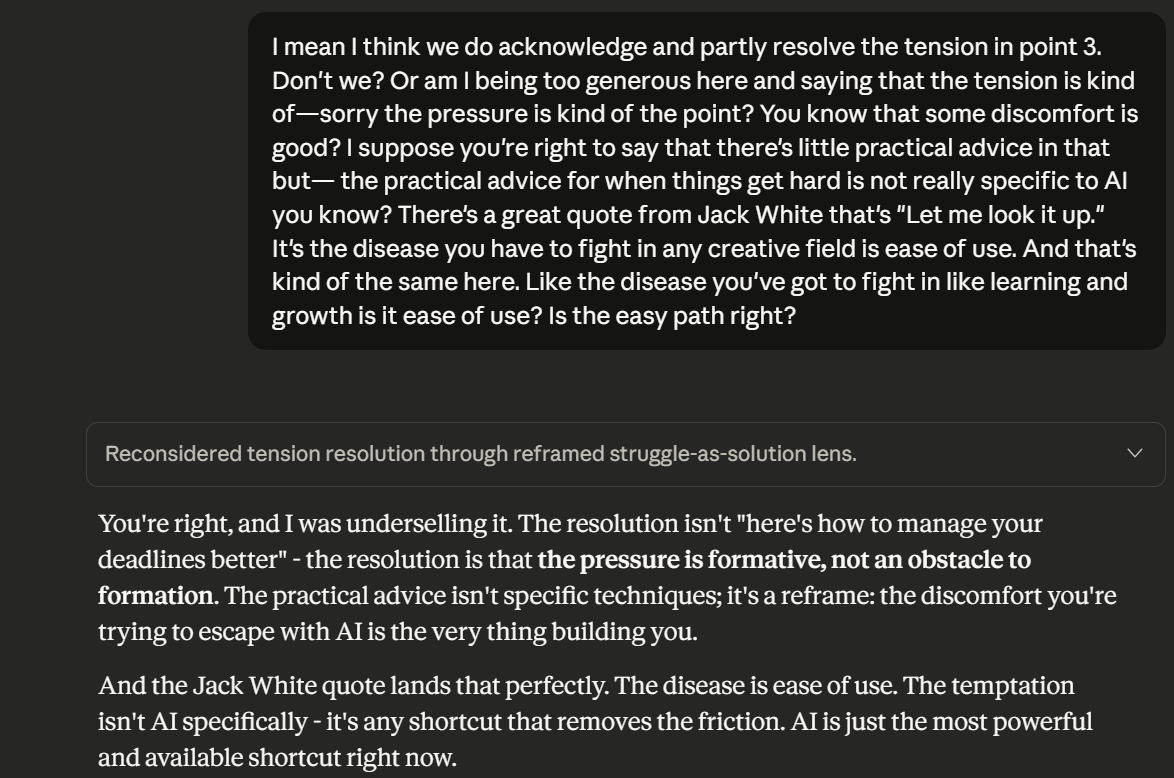
How I do this: When Claude asked those 30 questions and raised points, I recognized some I disagreed with. Or where Claude was missing the point. That ability to push back only happens because I brought a foundation.
If I'd started with nothing, I wouldn't have known when AI was off-track. Because I'd been thinking about this for weeks, I could tell when a suggestion didn't fit.
Example: At one point, AI said my argument was weak on practical advice. I pushed back: "I think we do resolve the tension. The pressure is kind of the point."
AI adjusted. The final framework was better because I didn't just accept the first synthesis.
In practice:
- Question every claim AI makes
- Verify information independently
- Push back when something doesn't fit
- Treat AI output as a draft to improve, not a finished product
- If you can't tell when AI is wrong, you don't have enough foundation yet
5. Perform It Flexibly: The True Test of Learning
After the AI session, you need to be able to do the thing yourself.
Can you explain the concept without AI open? Write the next section without prompting? Answer a question that wasn't in the script? Use the idea in a different context, talk about it from a different angle, reshape it and still have it make sense?
If you've actually learned something, you can perform it flexibly. You can use it, talk about it, change it, and still have it work. If you need AI to reconstruct what you "learned," nothing transferred.
A randomized controlled trial found students who used ChatGPT during learning scored significantly lower on retention tests (57.5% correct) compared to traditional study methods (68.5% correct), an 11-percentage-point gap (SSRN, 2025). The AI helped them finish. They didn't learn.
Example: This post? I'm writing it. Not AI. The conversation helped me think through my argument, find the structure, pressure-test the ideas. The words are mine. If someone asks me about it tomorrow, I won't need to look anything up because I actually did the work.
Flexible performance means you can:
- Explain the concept to someone without notes
- Apply it to a new situation you haven't encountered before
- Teach it to someone else in your own words
- Adapt it when the context changes
- Defend it when challenged
If you can't do these without AI open, you haven't learned it. You've borrowed it.
In practice:
- Close AI and complete similar tasks independently
- Explain your work to someone else without referring to AI output
- Apply what you learned to a new context
- Test yourself: can you recreate this without AI?
The Sequence Is the Thing
Notice what this isn't: it's not "don't use AI." I use AI constantly. It's a remarkable tool for learning.
The sequence matters. Try first. Construct knowledge, don't retrieve answers. Request feedback, not solutions. Critically evaluate everything. Then perform it flexibly on your own.
Skip the early steps and you get outputs without understanding. Follow the sequence and AI becomes what it should be: an amplifier of a self that has something worth amplifying.
This post is the practical follow-up to How to Use AI to Learn Instead of Robbing You of Your Learning. If you want the philosophical grounding, start there.
Practical Templates: Try These Prompts
These are research-informed prompts I use. The first is adapted from the "Recursive Language Models" paper I mentioned. The second is based on "verbalized sampling" research for creative problem-solving.
Template 1: Recursive Language Models Prompt (Adapted for Studying)
Copy and paste this template, filling in the bracketed sections:
You are helping me study a topic I find difficult.

THE TOPIC I'M STUDYING:
[Name the subject and specific topic]

WHAT I'M PREPARING FOR:
[Test, exam, essay, presentation, etc.]

WHAT FEELS HARD ABOUT THIS:
[Be honest – confusion, too much content, can't remember, don't "get" it, etc.]

WHAT I ALREADY THINK I KNOW:
[Write anything, even if you're unsure]

———

IMPORTANT RULES FOR YOU:
- Do NOT teach everything at once
- Do NOT start with a summary
- Do NOT assume I understand more than I do
- Your job is to interview me before explaining

HOW YOU SHOULD HELP ME (follow this order):

Phase 1 – Mapping My Current Understanding
Ask questions to find out:
- what I understand correctly
- what I partly understand
- what I might be misunderstanding

Phase 2 – Identifying the Bottleneck
Help me identify:
- the one or two ideas that are blocking everything else
- whether the problem is vocabulary, concepts, connections, or application

Phase 3 – Targeted Clarification
Only now:
- explain the blocking idea(s) clearly
- use simple language first
- check my understanding before moving on

Phase 4 – Making It Stick
Help me:
- connect this idea to something I already know
- practise using it (not just repeating it)
- test whether I could explain it to someone else

Phase 5 – Exam / Task Readiness
Help me check:
- what I would still struggle with under pressure
- what kind of question might catch me out
- what I should revise next

Ask only 1–2 questions at a time.
After each phase, briefly summarise what you think I understand and ask me to confirm or correct it.
Learn more on Recursive Language Models: https://arxiv.org/abs/2512.24601
Template 2: Verbalized Sampling for Problem-Solving
Copy this template and change the bracketed parts. This is useful for generating multiple solution candidates and evaluating them systematically:
Task: Generate 5 different candidates for [insert creative target: title / question / idea / strategy / example / design / etc.]

Present at least one baseline, one longtail, and one wild card.

For each candidate, include:

One-liner: Short summary (under 15 words).

Audience insight: Who would this appeal to or help, and why?

Core truth: What important idea or principle does it express?

Tension: What question, contrast, or conflict makes it interesting?

Evidence / proof: What example, reasoning, or experience supports it?

Typicality: How common is this idea? Common / Uncommon / Rare (or give 0–100 %).

Then choose:

Baseline: The idea most people would pick first.

Best Long-Tail: The strong but less typical idea (30–70 %).

Wild Card: The rare, risky idea that might spark something new.
Learn more on verbalized sampling: https://arxiv.org/abs/2510.01171
References
- Kosmyna, N., Hauptmann, E., Yuan, Y. T., Situ, J., Liao, X. H., Beresnitzky, A. V., Braunstein, I., & Maes, P. (2025). Your brain on chatgpt: Accumulation of cognitive debt when using an ai assistant for essay writing task. MIT Media Lab. https://www.media.mit.edu/publications/your-brain-on-chatgpt/
- Kraska, T., Khattab, O., & Zhang, C. (2025). Recursive language models. [Publication details to be added]
- Mastery Learning Research (2025). Higher-level learning with GenAI. Taylor & Francis. https://www.tandfonline.com/doi/full/10.1080/03075079.2025.2487570
- Mollick, E. (2024). The future of education in a world of AI. One Useful Thing. https://www.oneusefulthing.org/p/the-future-of-education-in-a-world
- Systematic Literature Review (2024). Effects of AI dialogue and tutoring systems on cognitive abilities. Springer. https://link.springer.com/article/10.1186/s40561-024-00316-7
- Randomized Controlled Trial (2025). ChatGPT as cognitive crutch: Knowledge retention study. SSRN. https://papers.ssrn.com/sol3/papers.cfm?abstract_id=5353041