This may sound like one of those "teachers hate this one weird trick" things. It's not. It's more mundane and more important than that.
Open any subject guide. Pick any subject - English, Math, Chemistry, History, whichever. Flip to the grade descriptors for a 7. The word "evaluate" or one of its synonyms shows up every time.
The IB spends roughly zero time explaining what evaluation actually means or why it's the thing that separates a 6 from a 7. It's just there, embedded in every descriptor like architectural rebar you're supposed to notice on your own.
The Evidence (It's Everywhere)
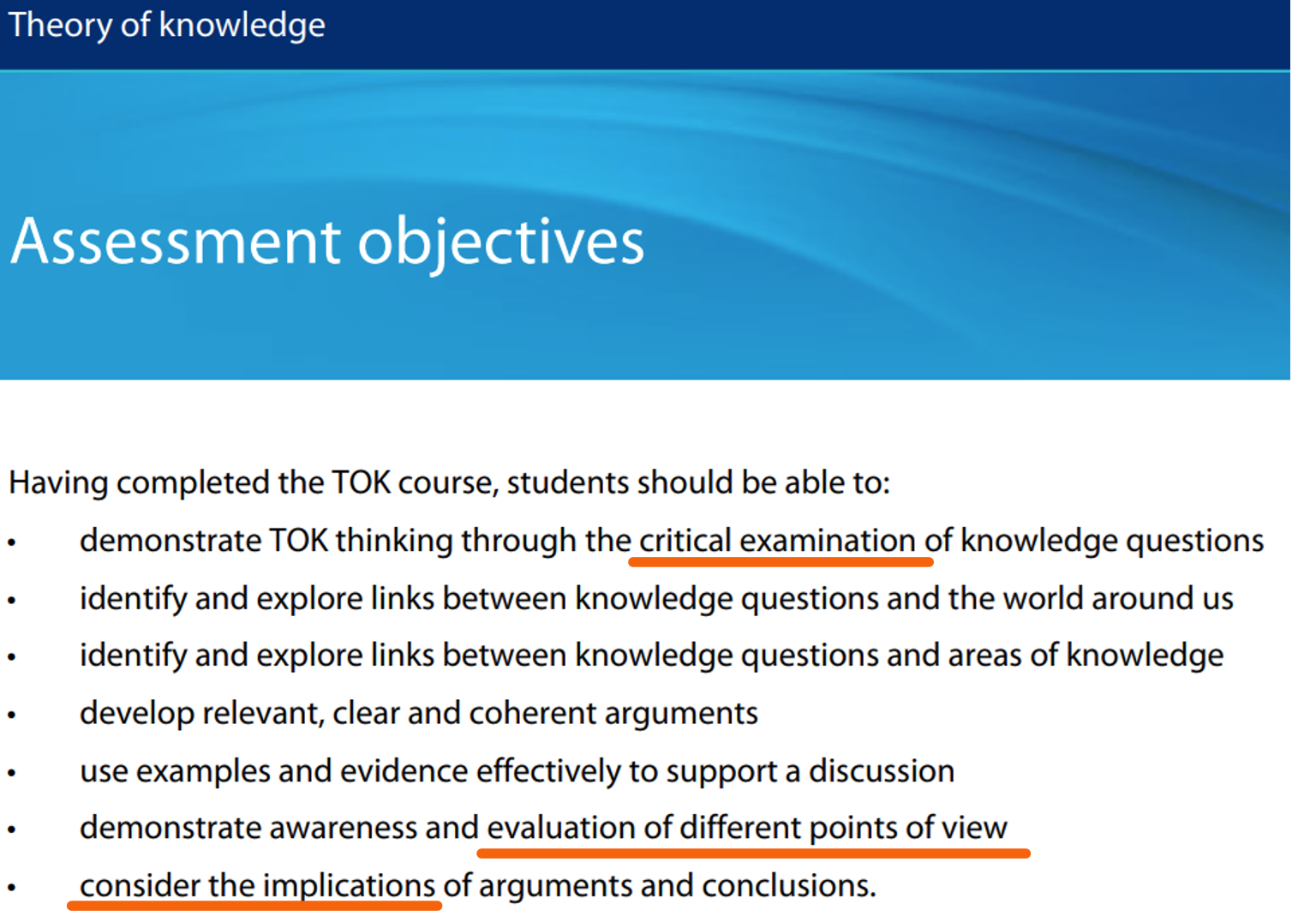
Start with Theory of Knowledge. Right there in the assessment objectives: "critical examination" and "evaluation of different points of view." ToK gets treated like this separate philosophical exercise you do on Tuesdays, but it's actually just making explicit the skill that's already hiding in every subject at the 7 level.
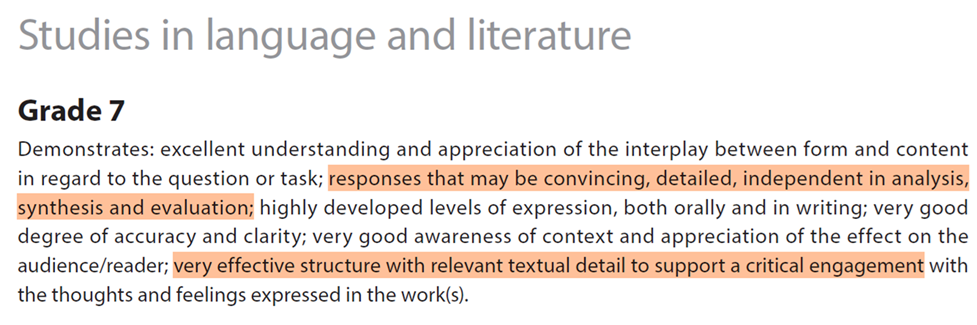
Language and Literature. Grade 7 requires "analysis, synthesis and evaluation" plus "critical engagement." The word is right there.
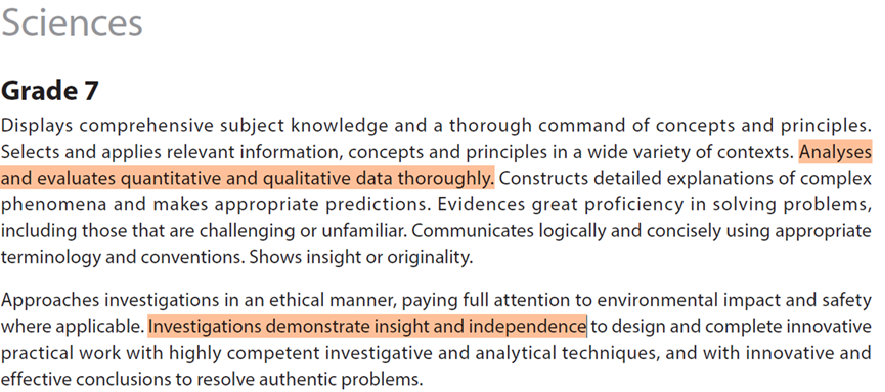
Sciences. "Analyses and evaluates" plus "Investigations demonstrate insight and independence." Same pattern.
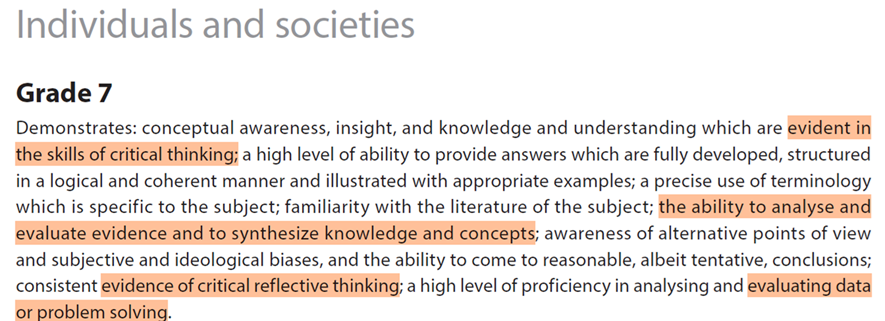
Individuals and Societies. Mathematics. The Arts. Every single subject group. The IB is showing you exactly what they value. The thing is, most students treat it like just another word in the rubric instead of the actual mechanism that determines your grade.
What Evaluation Actually Does (The Part Nobody Explains)
The gap between a 6 and a 7 is not a content gap. You can memorize the entire syllabus and still max out at a 6 if you don't understand what evaluative thinking is actually doing.
The official descriptor for Grade 7 in Individuals and Societies says:
"Produces well-structured, focused and analytical work demonstrating a high degree of critical engagement with relevant source material. Integrates evidence to support arguments effectively. Applies a range of relevant historical skills with precision. Evaluates different perspectives."
That last line is doing specific work. Let me show you the difference.
Say you're writing about the causes of the Rwandan genocide. A 6-level response would explain the ethnic tensions between Hutus and Tutsis. It would cite the role of colonial powers in creating those divisions. It would discuss the immediate political triggers. It would reference specific historical evidence and demonstrate clear understanding of different historiographical interpretations.
That's legitimately strong work. You could write a thorough, well-evidenced response doing exactly that and get a 6.
The 7-level response does something different. It might start by questioning why we frame the genocide primarily through ethnic identity in the first place. It examines whose narratives dominate the historiography and whose voices get excluded. A 7-level response might point out that framing it as "ancient tribal hatreds" serves specific political purposes. It obscures the role of international actors and treats violence as somehow inevitable or cultural rather than political and constructed.
This is what "evaluates different perspectives" actually means in practice. You're stepping outside the framework to examine how the framework itself operates. You're not adding more perspectives to your analysis. You're questioning which perspectives are worth considering in the first place and why certain narratives have more weight than others.
The Architecture Underneath (Zoom Out, Then Zoom Back In)
Most of your learning in the IB happens inside systems. You learn the rules of stoichiometry. You memorize the conventions of literary analysis. You understand economic models. You work within frameworks. This gets you to competence. This gets you to a 5 or 6.
Evaluative thinking requires something harder. You have to be able to zoom out, see the system as a constructed thing with boundaries and limitations, and assess where it works and where it breaks down. Then—and this is the part that makes it difficult—you zoom back in and keep using it anyway.
Example. You're analyzing The Great Gatsby using the Marxist literary criticism framework. A 5-level response describes class divisions in the novel. A 6-level response analyzes how those divisions structure the entire narrative and uses specific textual evidence to support the interpretation.
A 7-level response does all of that, and then it steps back and points out that Marxist criticism itself has limitations. It might note that this framework tends to flatten the gender dynamics in the text, or that it treats economic class as the primary axis of power when the novel is also deeply concerned with regional identity (East Egg vs. West Egg vs. the Valley of Ashes). It acknowledges that using a Marxist lens illuminates certain elements while obscuring others.
Then it keeps using the framework anyway because it's still valuable. That's the zoom out, zoom back in motion. You gain altitude to see the system's boundaries, then you descend back into it while remaining aware of what it can and can't do.
Why Students Miss It (And Why That's By Design)
The pattern is hiding in plain sight. Every subject. Every descriptor. So why do students walk right past it?
Because evaluation looks like extra work stacked on top of content that's already overwhelming. It feels like the thing you add once you've mastered everything else. The finishing touch. The cherry on top of an already complete essay.
This gets the sequence entirely backwards. Evaluative thinking isn't decoration. It's the thing that makes the learning stick in the first place. When you're constantly asking "where does this framework apply and where does it break down?" you're building a more durable understanding than if you just memorize the framework's claims.
The IB doesn't spell this out explicitly because - and I'm speculating here - the whole programme is structured around discovery learning. You're supposed to figure it out by doing ToK and then recognizing the pattern in your other subjects. The problem with this approach is that it advantages students who already come from environments where this kind of meta-cognitive thinking is modeled. If your parents are academics or your dinner table conversations involve questioning assumptions, you'll spot the pattern faster. If not, you're left wondering why your friend who knows less content than you keeps scoring higher.
The ToK Connection (Why It Exists At All)
This is why ToK exists as a core requirement. It's explicit practice for the exact skill every subject demands at the highest level but never directly teaches.
When you write about knowledge frameworks in ToK - questioning the scope and limitations of historical methodology or scientific paradigms - you're developing the same cognitive move you need when you evaluate different economic models in Economics or assess the validity of a psychological study in Psychology.
ToK makes the invisible visible. It takes the skill embedded in every grade descriptor and gives you a space to practice it explicitly. Then you're supposed to export that skill back to your other subjects. Most students treat ToK as this weird standalone thing they have to do for the core requirements. That's the wrong way to think about it. It's training wheels for a skill you're already being graded on everywhere else.
What This Changes (If You Actually Believe It)
If evaluation is the pattern running through every grade descriptor, it suggests a different approach to the entire diploma.
Content knowledge matters. You can't evaluate what you don't understand. But understanding alone won't get you to a 7. You need the habit of testing boundaries, of stepping outside systems to see how they're constructed, of asking which perspectives get privileged and which get marginalized.
This is the actual mechanism the IB uses to differentiate between students who can operate within frameworks and students who can operate on frameworks. That second thing is what they're calling "critical engagement" and "higher-order thinking" and "evaluation."
The pattern has been in every grade descriptor all along. Now you've seen it. The question is whether you'll start using it or keep treating evaluation like just another word in a rubric you're supposed to hit once per essay.