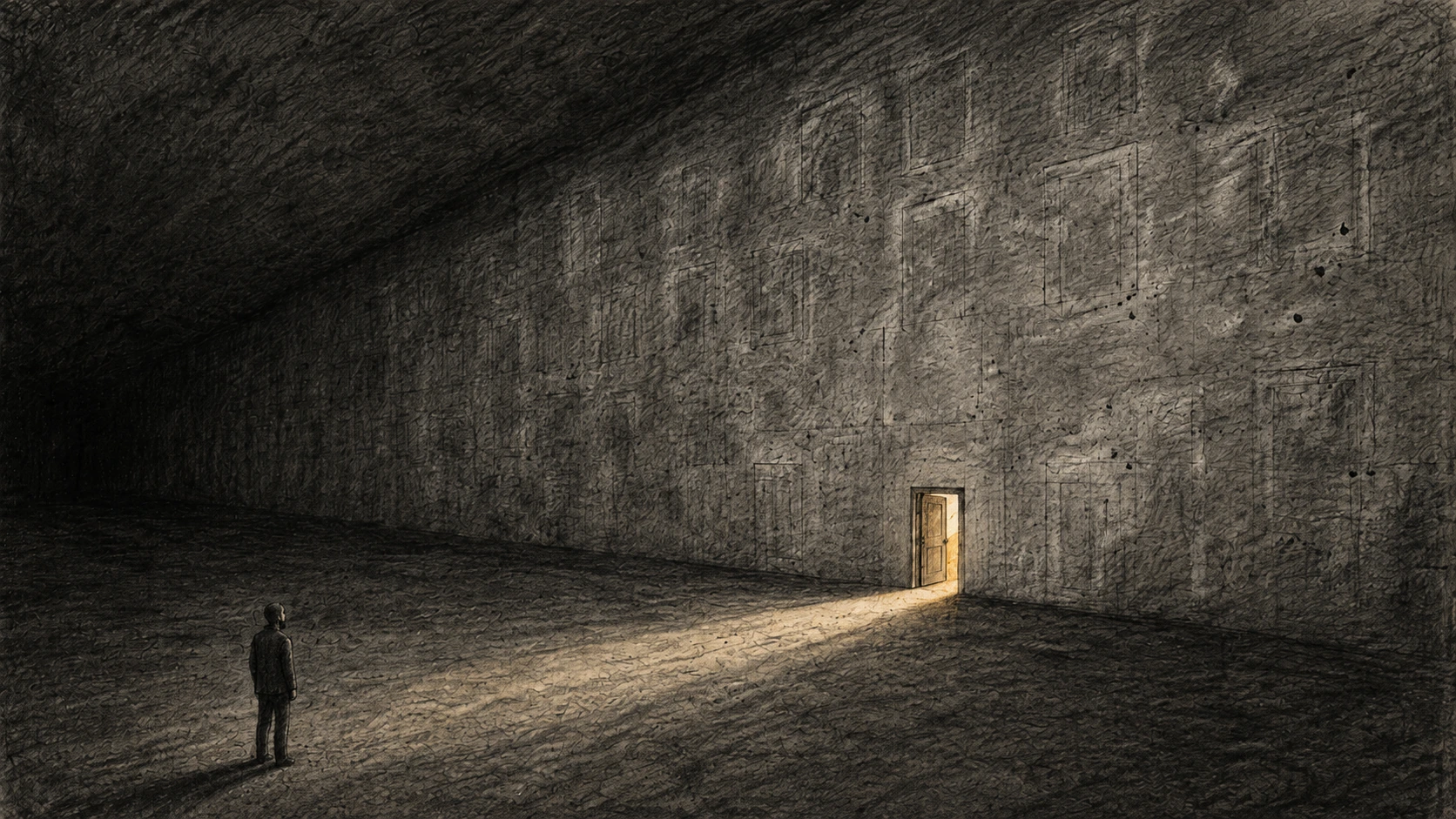
Somewhere in The Philosophical Journey, an old philosophy textbook by William Lawhead, there are instructions on how to ride a bicycle.
They run roughly like this. Hold your balance by winding along a series of appropriate curvatures, and for a given angle of imbalance the curvature must be inversely proportional to the square of your speed.
The rule is Michael Polanyi's, and despite appearances he is not teaching you to ride a bike.
He is drawing a distinction between knowing how and knowing what. He says:
You obviously cannot adjust the curvature of your bicycle's path in proportion to the ratio of your unbalance over the square of your speed; and if you could you would fall off the machine.
Knowing how to ride a bike lives in the act. Stating the rule explicitly, and then trying to use it, would actively inhibit the knowing it describes.
I have been thinking about this because of something that happens when I use an LLM like ChatGPT or Claude, and it is not the thing people usually complain about. The usual complaint is inaccuracy: hallucination, confabulation, whatever we are calling it these days. Dan Klein on the podcast Beyond the Prompt puts the underlying design plainly — these are systems built to produce output indistinguishable from the truth, which is a different specification from producing correct answers. However, even an answer that is entirely accurate flattens perspective, removes texture.
To see what gets removed, it helps to look first at what happens in a person. The machine is doing a version of the same act. You cannot recognise it there until you have watched it somewhere you already trust.
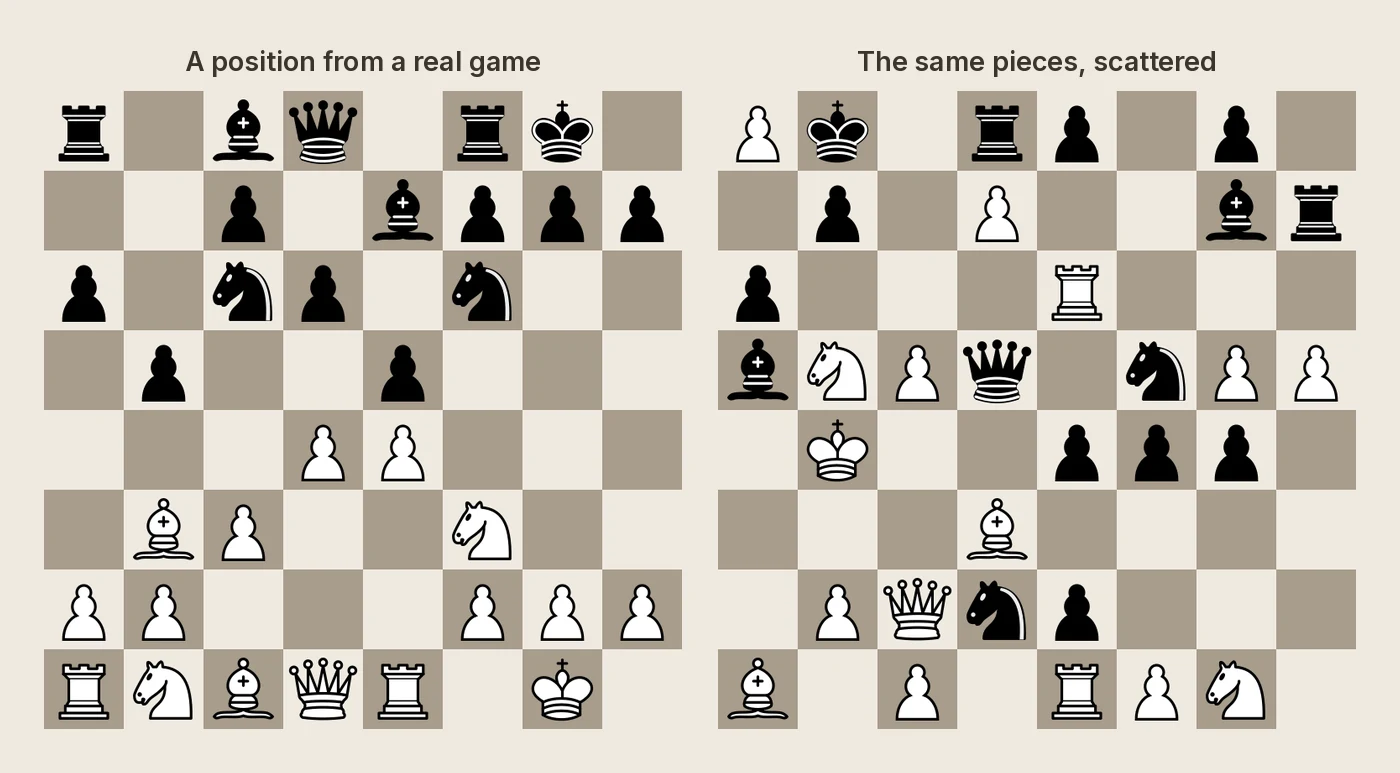
This can be seen across more or less any example of tacit knowledge. Hubert Dreyfus called it trained salience. A chess master does not consider the bad moves and reject them. The bad moves never appear. Adriaan de Groot demonstrated this in 1946 by asking players of different strengths to think aloud: the masters did not search more moves than the weaker players, they searched different ones. Chase and Simon furthered it: masters reconstruct a real position from a few seconds' glance far better than novices, but scatter the same pieces at random and the advantage nearly vanishes. Take the meaning away and the master is ordinary. The board arrives already carved into paths, and the carving happens before any thinking the master would recognise as thinking.
It shows up in stranger places too. Harold Kundel and Calvin Nodine found that radiologists sort normal films from abnormal ones at better than chance within about half a second, before any systematic search has begun. The impression forms first and then decides where the eyes go. So something is being decided in these cases and nobody is deciding it. Nobody chose what to foreground and what to let recede. It happened, and it happened as part of the doing rather than somewhere before it.
The obvious objection is that nothing was really chosen here, so nothing was really decided. I arrived at that objection myself last month, reading Karen Barad's Meeting the Universe Halfway, and I think it is wrong in an interesting way. Foregrounding is an act, and not all acts are choices that you make. Tacit knowledge foregrounds despite it not being a choice.
Barad, borrowing the initial idea from Niels Bohr, calls it an agential cut: the drawing of a line between what matters here and what does not, what comes forward and what stays back. Foreground, background. Her argument is that the instrument does not record a boundary that was already sitting there. It enacts one. These cuts get made in practice rather than stated in sentences, which is why no cyclist has ever located the rule she is following, and why asking her to would put her on the pavement.
In every case so far the cut was made by the person doing the knowing. Their own body, their own years of practice. Invisible, but invisible from inside a skill they actually have.
Now take a different case.
A student learns that the Second World War ended in 1945.
If we consider what cut was made here, certainly the student did not make it. Someone else did, long before the student arrived, and the decision about what to foreground was less obvious than the date makes it look. What does it mean for a war to be over? That the fighting stopped? That a government surrendered? That someone signed something? Those are three different instruments, and they do not give three readings of one event. They give three events. Britain marks VE Day on 8 May and Russia marks it on 9 May, and that is not two views of the same afternoon. It is two signings, two chains of authority, two national holidays that are still observed apart.
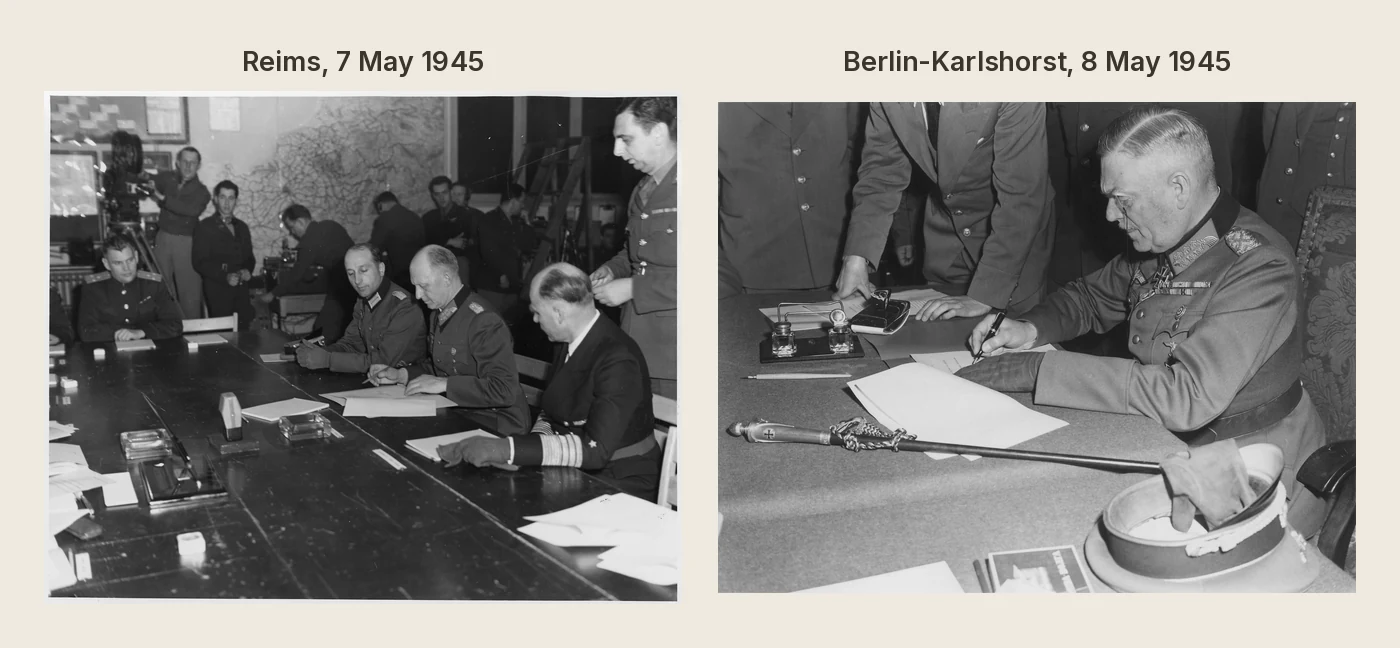
None of which makes 1945 wrong. A cut made by somebody else is not thereby arbitrary and it is not thereby bad. Foregrounding the surrender of governments over the movement of individual soldiers is a defensible thing to foreground, settled by a community who thought about it. What it is not is a discovery. There was no single fact of the matter lying underneath, waiting to be reported accurately.
There is an issue though in that the student receives the result of a decision in the shape of a fact. What arrives is a date. This is mostly fine, because as teachers we want our students to interrogate these facts and the reasoning that led us to these cuts. In my own school history lessons we learned about Hiroo Onoda, the last person to accept the end of the war.
Onoda was a Japanese intelligence officer who kept fighting in the Philippines until 1974. The story was originally told to me as a curiosity, a man so cut off he never got the news, still at war three decades after everyone else went home. But he had the news. Leaflets reached him. Newspapers reached him. His own family called for him through loudspeakers. He had reasons, of a kind, to distrust all of it.
What eventually worked was not information. Norio Suzuki found him in the jungle, then went back to Japan and tracked down Onoda's former commanding officer, Major Yoshimi Taniguchi, by then working as a bookseller. Taniguchi flew to Lubang and formally rescinded the order he had given in 1945. Onoda surrendered the next day, in March 1974.
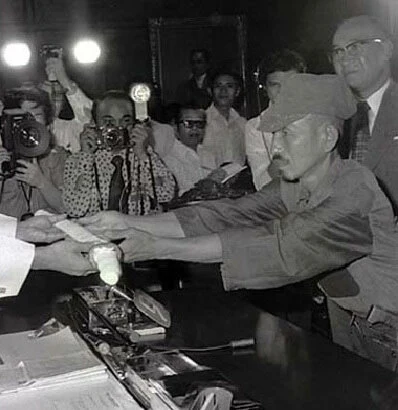
He was not waiting to be told a fact. He was waiting for the authority that drew his boundary to come back and redraw it. On his reading of what counts as a war being over, it was not over, and he behaved accordingly for twenty-nine years, to the point where he still killed people.
Unlike with tacit knowledge though, you can actually see the cut Onoda made, and you can see it for one reason: it differs starkly. A cut stays invisible right up until you meet somebody who enacted a different one, at which point it stops looking like the world and starts looking like a decision. Which is exactly what the machine will not give you. It has averaged over every cut anyone has made on the question.
Ask an LLM (especially a free one) when the Second World War ended and it will not tell you the question has more than one defensible answer. It gives you the most common well-grounded answer in what it was trained on, which for an English-language model means largely American and British sources. The answer will be correct. It will also be the average of a great many cuts, presented as the shape of the world.
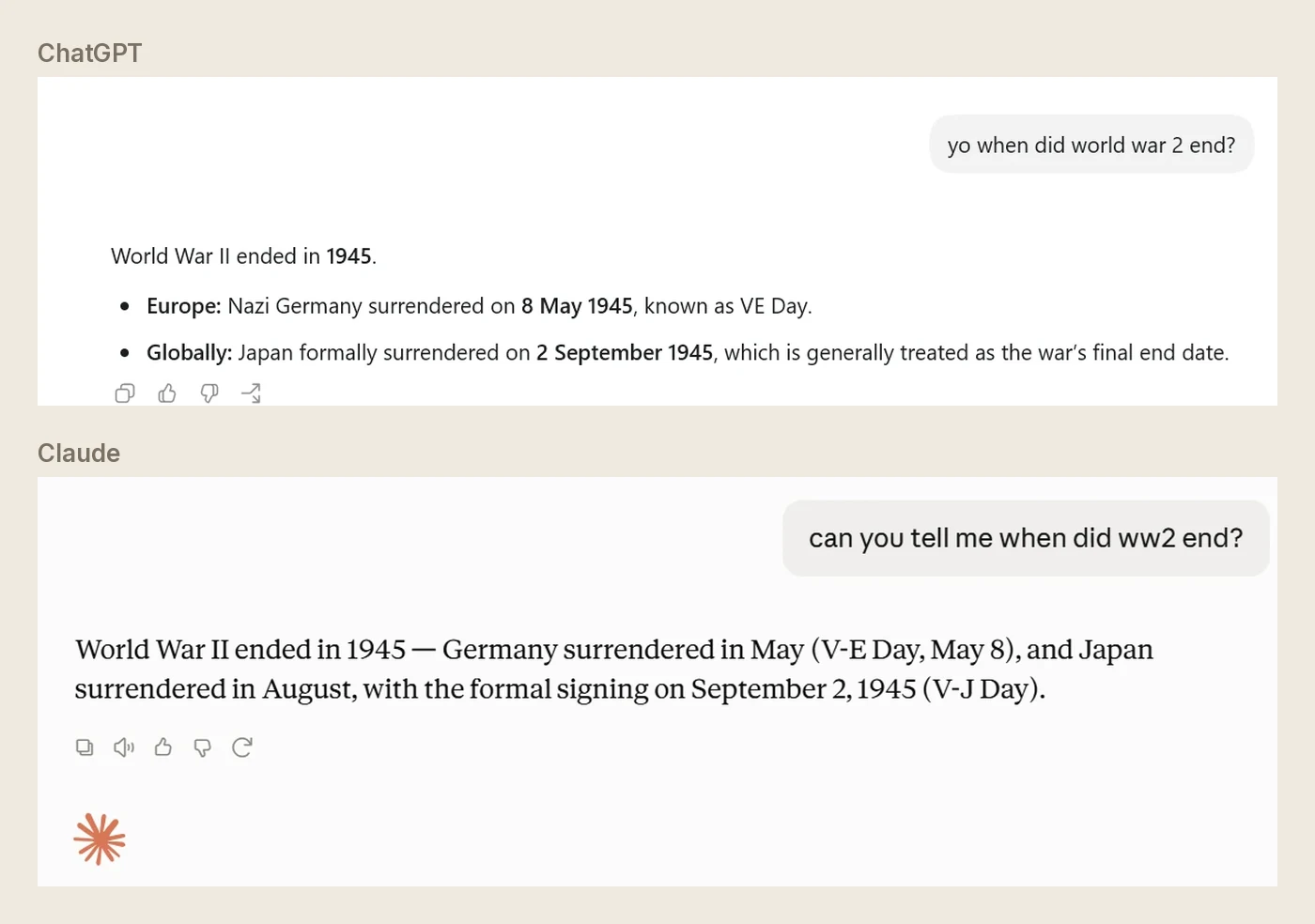
That is what a model is, structurally: a mean of the cuts already made on whatever you asked about. It is tempting to say that this makes it no cut at all, that a mean is a smear where a cut is a boundary. I think that gets it backwards. Averaging is not a way of describing the spread of opinion. It is a way of ending it. Before you ask, there are many answers carrying different weights. After you ask, there is one, and the rest are not in the background. They are absent, and nothing in the reply indicates that they were ever there.
When the chess master stops seeing the bad moves, the bad moves are still on the board. The alternatives survive the act. When the model hands you a sentence, the alternatives do not survive it. You could object that they are still there in the weights, that one more sample would surface them, and that is true. It does not help. Nobody asking a question meets the weights. They meet a paragraph.
The flattening is measurable. A team led by Dustin Wright tested twenty-seven models across a hundred and fifty-five topics, twelve countries and two hundred prompt templates drawn from real user conversations, and found every model less epistemically diverse than an ordinary web search. Newer models did better than older ones and yet still lost to search. And if you happen to have used a Google Search before you know it's not a bastion of diverse thought.
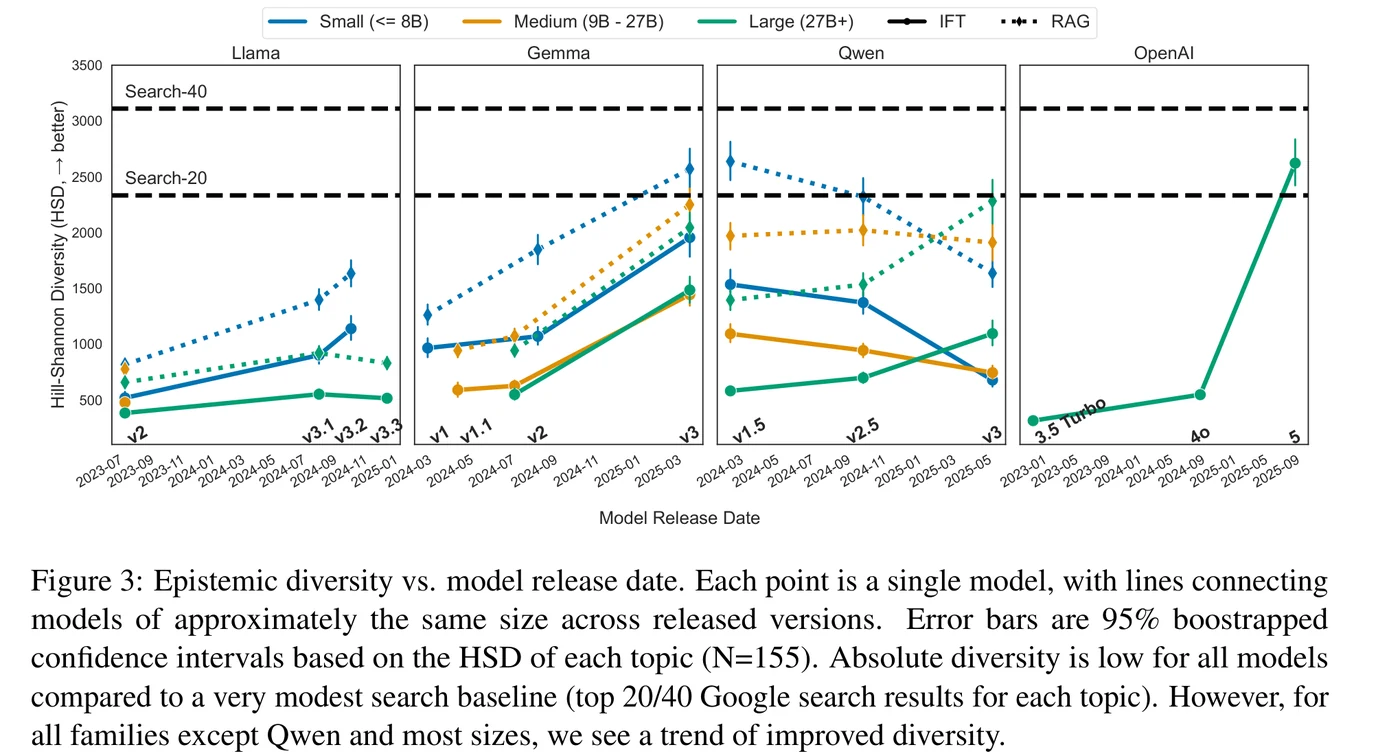
The machine is not the author of the perspectives it flattens. Annotators and sources made those. Work by Jiayi Zhang and colleagues on what they call verbalized sampling locates the driver not in the architecture but in the training data: annotators building preference data systematically favour text that sounds familiar. That is where the cuts it averages over were made. An annotator picking this phrasing over that one is doing the thing the radiologist does and the thing the curriculum committee did, drawing a line between what matters here and what does not, except that they are paid by the hour to do it at scale for a stranger. Those are agential cuts and they have a named cause. What reaches you is their average.
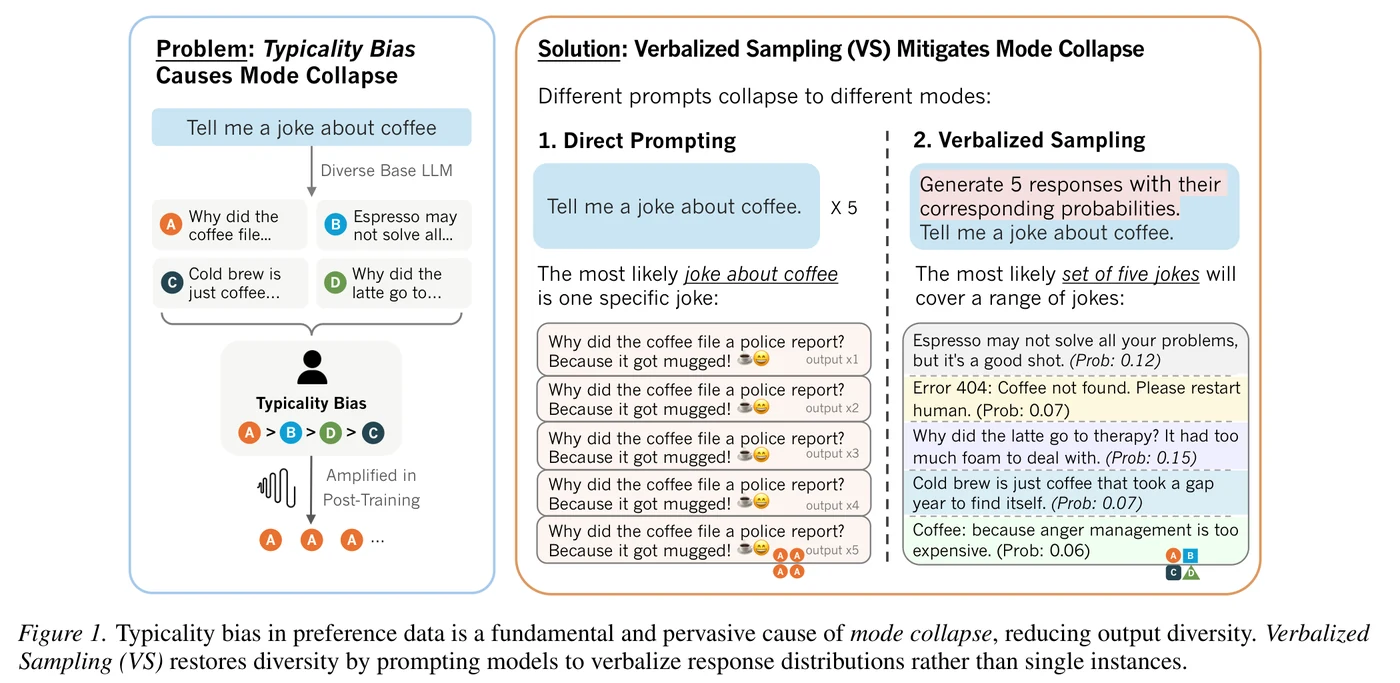
Zhang's mitigation is unreasonably simple. Ask the model for several responses along with the probability it assigns to each, rather than for the answer, and the diversity roughly doubles or triples. There are others. Ask what a historian in Tokyo would foreground. Ask what the second-most-common answer is and why it lost.
So the situation is recoverable, which is the good news, and the bad news is the shape of the recovery. Knowing the technique is not the same as remembering to use it. Every mitigation is a cognitive tax, payable on every prompt, forever, by someone who is usually busy and often tired. You will fail to pay it. I fail to pay it.
And there is a further complication that I think is genuinely hard rather than merely inconvenient. Sometimes the flattened answer is the one you want. The average of everybody's cuts is frequently the best thing available to you, and demanding five perspectives on a question that has one useful answer is its own kind of failure. So the tax is not simply a matter of remembering. It is a judgement, made fresh each time, about whether this is a question where the consensus serves you or a question where it quietly removes the thing you needed.
Which is a strange place to end up. The most confident thing I can say about using these tools well is that it requires you to keep noticing what has been left out, in a medium engineered to make nothing look as though it is missing.