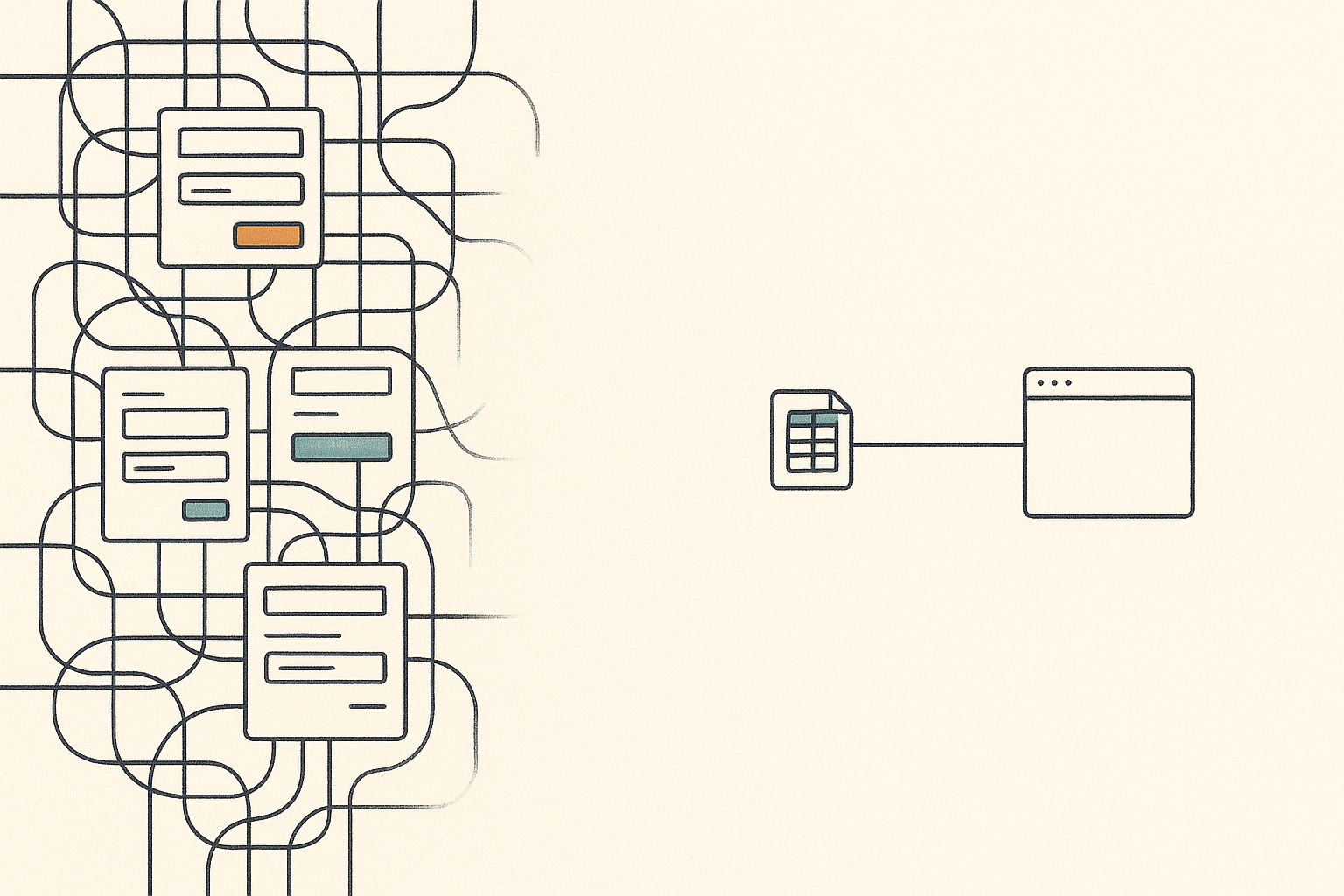
For weeks I'd been trying to give my English B class a website to publish their magazine on, and every route hit a different wall. Canva ruled out under-18 users. Bolt cleared that bar, but our IT team flagged that it would still send student data out of the country, which the rules here in China don't allow. Back to Canva on the IT team's suggestion, where the wall was a different shape: Canva builds a good-looking shell and nothing more. The page it publishes can't be edited and nothing on it is really clickable.
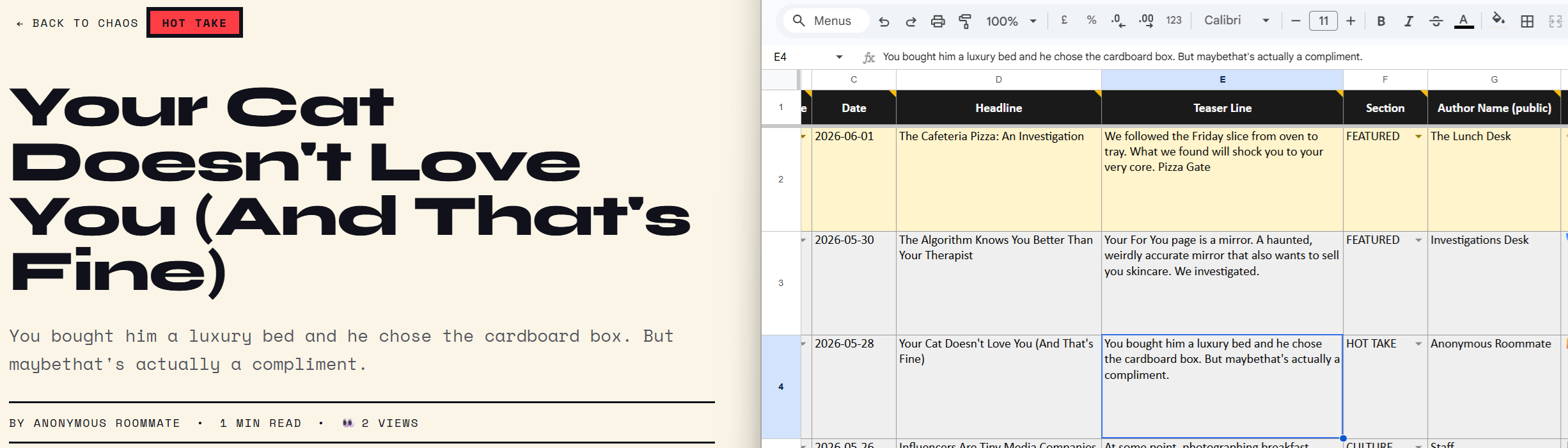
Every move I made was the same shape: find a platform my students could sign up for. That was the wrong question. They didn't need to sign up for anything. They'd already designed and vibe-coded the shell in Canva, so I took that, rebuilt it on Lovable under my own account, and wired the finished site to a single spreadsheet. The site is a small React app, and where it used to keep its articles in the code, it now reads them from the sheet: one row is one article, a “Show on Site” switch turns a draft live, and editing a cell changes the page. The site never shows a student's real name; they write under a pen name, or none at all. No accounts, no logins, nobody signing their data away to a platform. All anyone needs is a link to a sheet they can edit. The thing I'd spent weeks trying to add turned out to be the thing I had to remove: the requirement that anyone hold an account at all.
I'd been trying to add my way out of a problem that wanted subtraction. I knew exactly where I'd heard that.
Beyond the Prompt is where the idea first reached me, surfacing across episodes until I couldn't ignore it: the real measure of AI isn't what you use it for, it's what you stop doing because of it. Where it landed hardest was the Eric Porres episode. Count the reports nobody writes anymore, the workflows that collapsed from days into an afternoon, the artefacts that vanished because something else does the job now. The colleague quietly killing three recurring reports changed more than the one running forty clever prompts, and no dashboard will ever show it.
When I first heard it, I nodded. Made sense. Nodding along, it turns out, is not the same as believing something. The idea didn't land until I caught myself reaching for subtraction on the website without remembering when I'd decided to.
Once I had the lens, the pattern was already everywhere. There's a skill I built called LessonImprover that sharpens my teaching materials, adds the academic vocabulary my EAL students need, scaffolds the steep parts. I'd been subtracting from it for months without calling it that. The first version was bloated, hundreds of lines telling the model how to think. I kept cutting, and one pass took its footprint down by something like 80%. Paradoxically, the output got better as the instructions got fewer. The rules I'd written so carefully were scaffolding for a model that had stopped needing them.
It had even crept past work. I check my email far less than I used to. The digests do the first read now, running across my inboxes to tell me what's there. What I gave up wasn't the reading. It was the compulsion to triage in real time, the low hum of checking between lessons, the ritual that made me feel on top of things. I often choose not to open something, because I know it will surface in the digest and the digest will tell me whether it was worth my attention. Sometimes I go back and read the whole thing, but only because something other than my own anxiety decided it was worth reading.
A class project, a tool I built, a Tuesday morning. None of it shows up as an achievement. Subtraction leaves no artifact. You can point at the feature you shipped or the deck you made, but not at the report you stopped writing or the habit you let go. It is invisible by design, which is why no dashboard counts it, and why it took someone else saying it out loud for me to see my own.
Everyone measures AI by what it lets you do. Measure it by what it's let you stop. What have you deleted?