I had a Discord channel that tracked my dog's poops. My partner rated each one out of five. The sample grew to sixty-four ranked poops, and the numbers were clear: a photo with Jabba in the frame averaged 4.4, while the poop on its own managed 2.9 — which probably won't shock you. She wasn't really rating the poop. She was rating my dog pooping. Build time for the whole thing, start to finish, was about forty-five minutes.
I think this is one of the reasons I'm good at AI.
Nobody wires up a poop-rating pipeline for work. That is the point of it. When the cost of failing is zero, you'll try things you would never risk on a deadline: image relay, scheduling, how the AI holds memory across messages. I now know exactly where that Discord setup was solid and where it was fragile, and I know it because a beige French Bulldog needed his bowel movements graded on a five-point scale. If a real project ever needs those pieces, I've already found the friction. The channel itself never died, either — it outgrew the poops. These days it's the simplest possible door for my partner to reach my AI and use it however she likes: no setup on her end, no ins and outs to learn, she just asks for things in Discord.
This has happened to me before, and the mechanism is worth tracing, because the mechanism is the whole argument.
Late last year I cloned my own voice on ElevenLabs. The goal was to send friends dad-joke voice notes without holding the record button, a stupid thing I wanted for no reason beyond the stupidity of it. To make it work I had to install and configure a virtual microphone. Nobody installs a virtual microphone for a serious project; the activation cost is too high when there's a deadline breathing on you. For dad jokes, failure costs nothing, which is exactly why it was worth the setup. While I was poking around I half-noticed the platform also did speech-to-text. “So that exists,” I thought, and went back to my jokes.
Months later I needed to transcribe thirty hours of my own lesson recordings for a teaching analysis. Whisper on my own machine was crawling. I sat there running through options, and the dad-joke afternoon surfaced: ElevenLabs, speech-to-text, I'd seen it work. That's the tool that did most of the job. I could not have planned that. The silly project was the reconnaissance for the serious one, and I only know it in hindsight. The byproduct outvalued the product.
The two stories share a shape. Most AI advice assumes you already have the use case and only need to execute it better. Where the use cases come from is the question almost nobody answers. Play generates use cases. Iteration refines them. They're different skills, and nearly all the popular advice is about the second one. The biggest limit on what you can do with AI is what you can imagine doing with it, and imagination doesn't widen on command. It widens by messing about.
Last week the same reflex did something that hit harder than I was ready for.
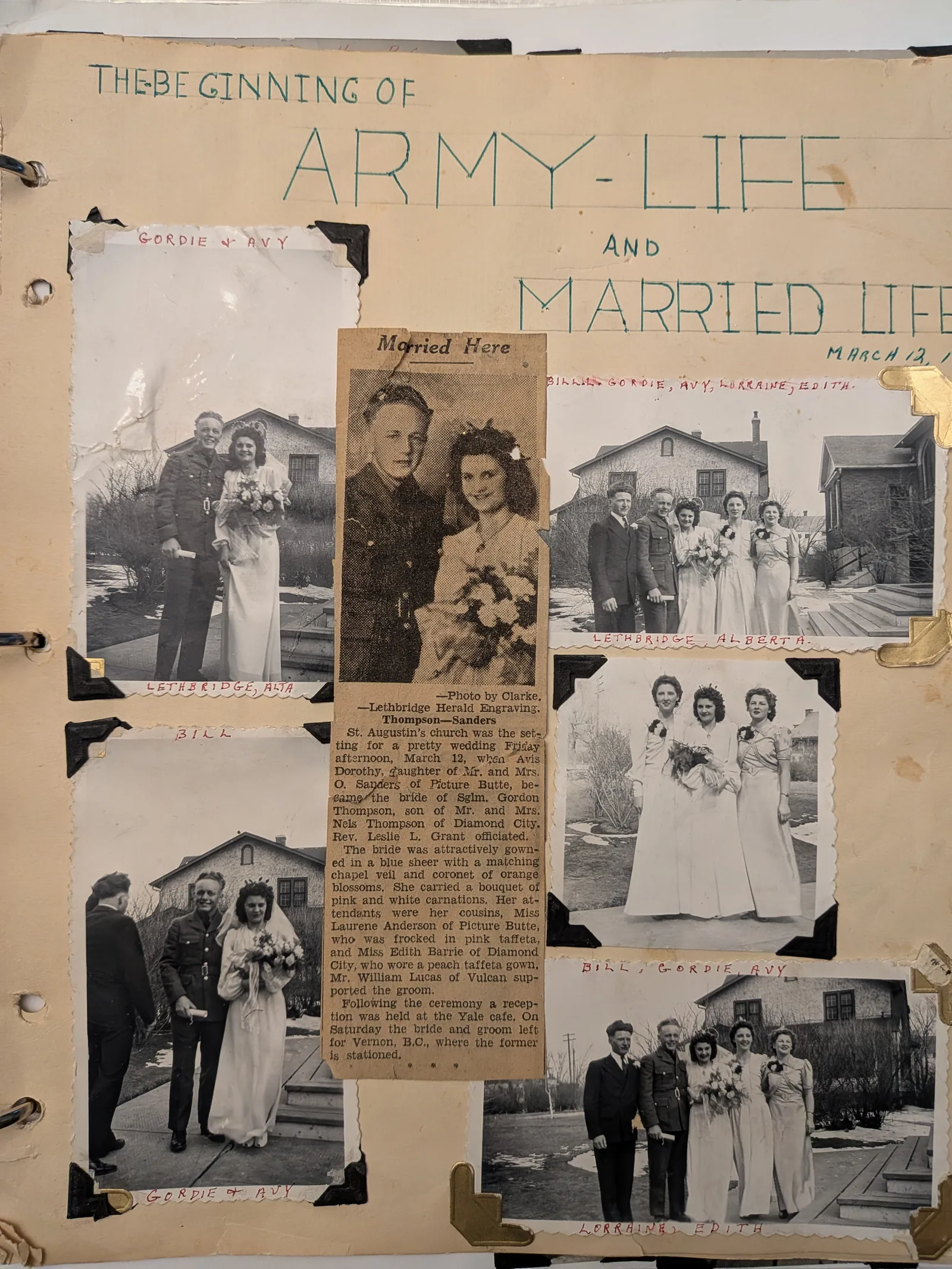
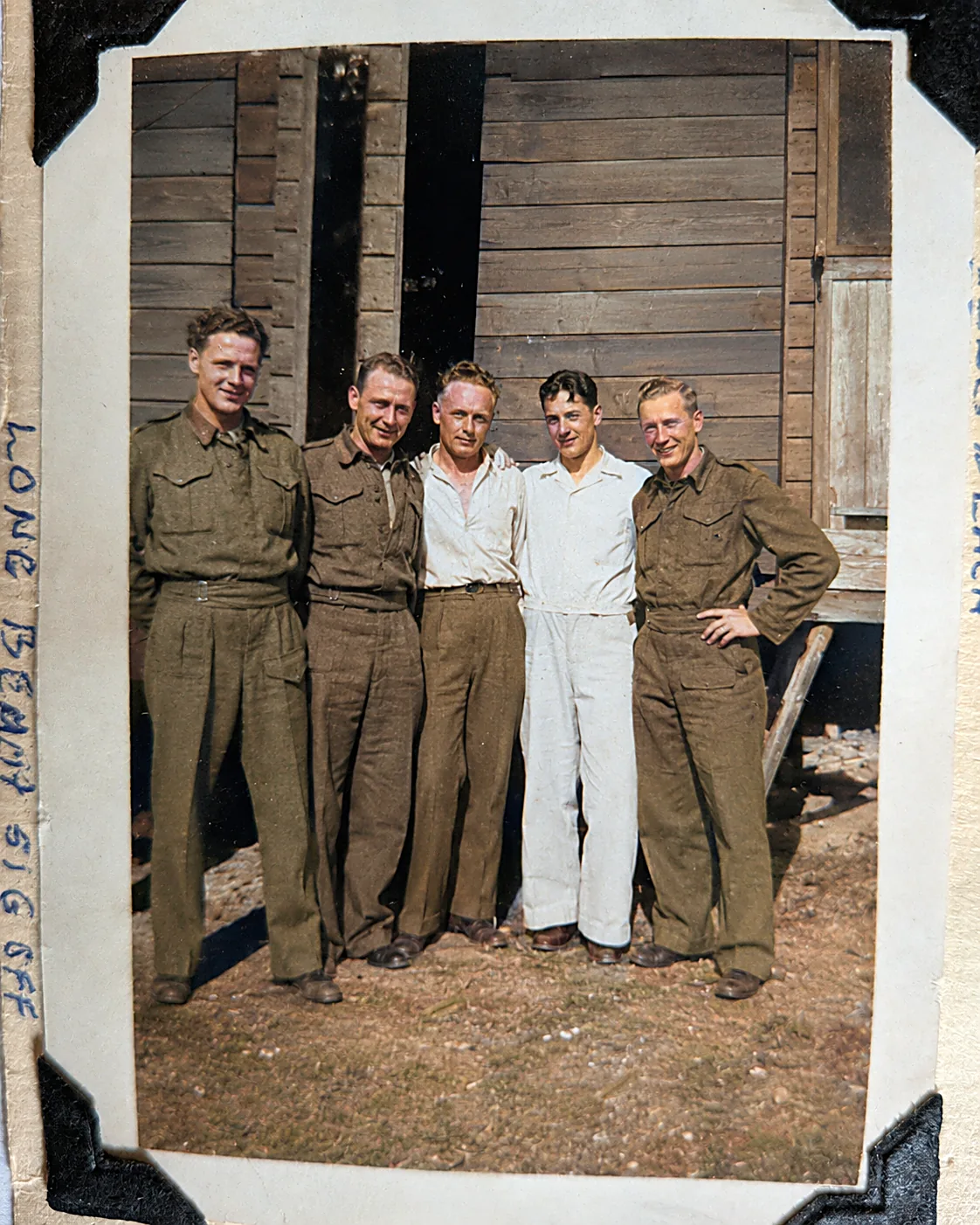
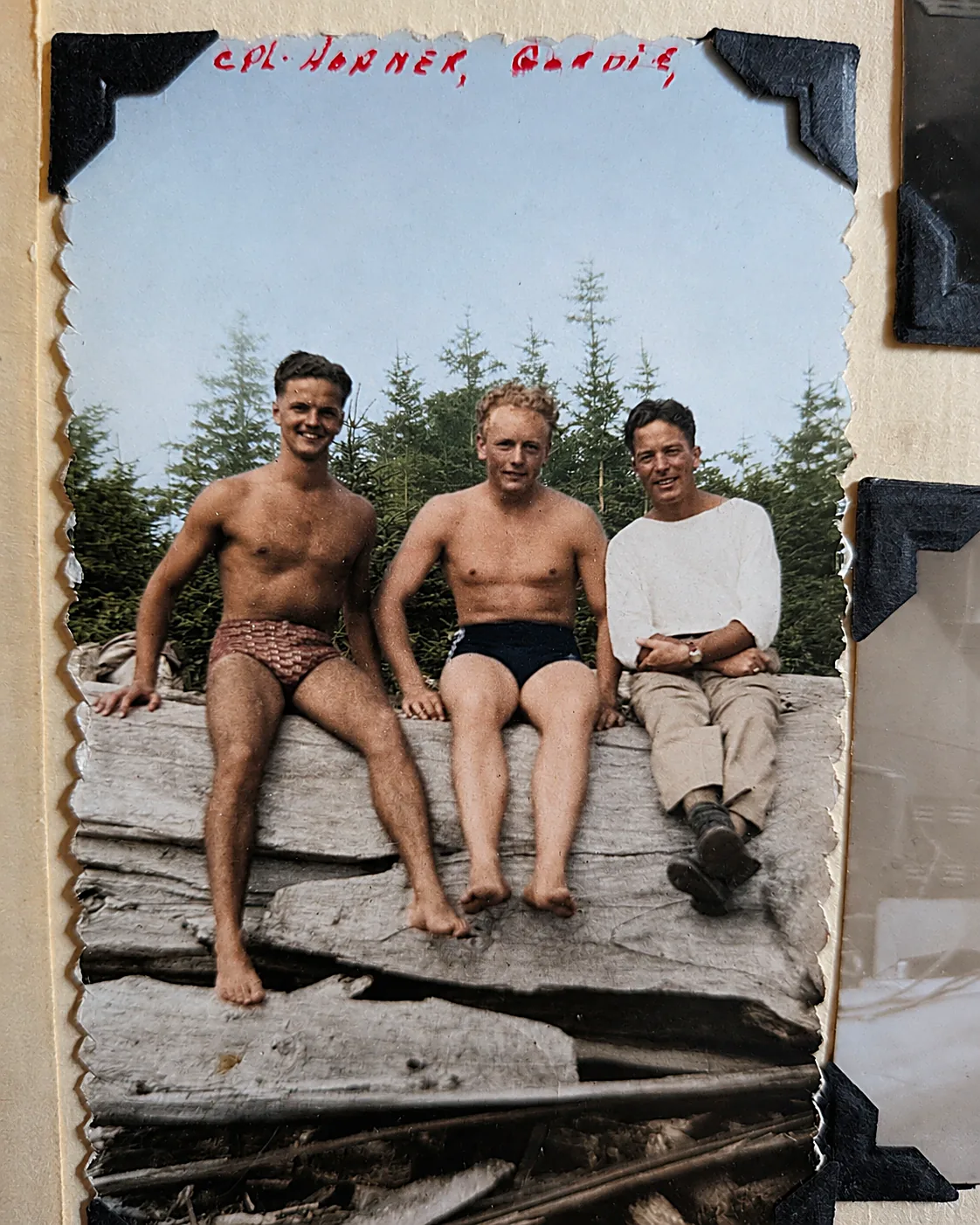
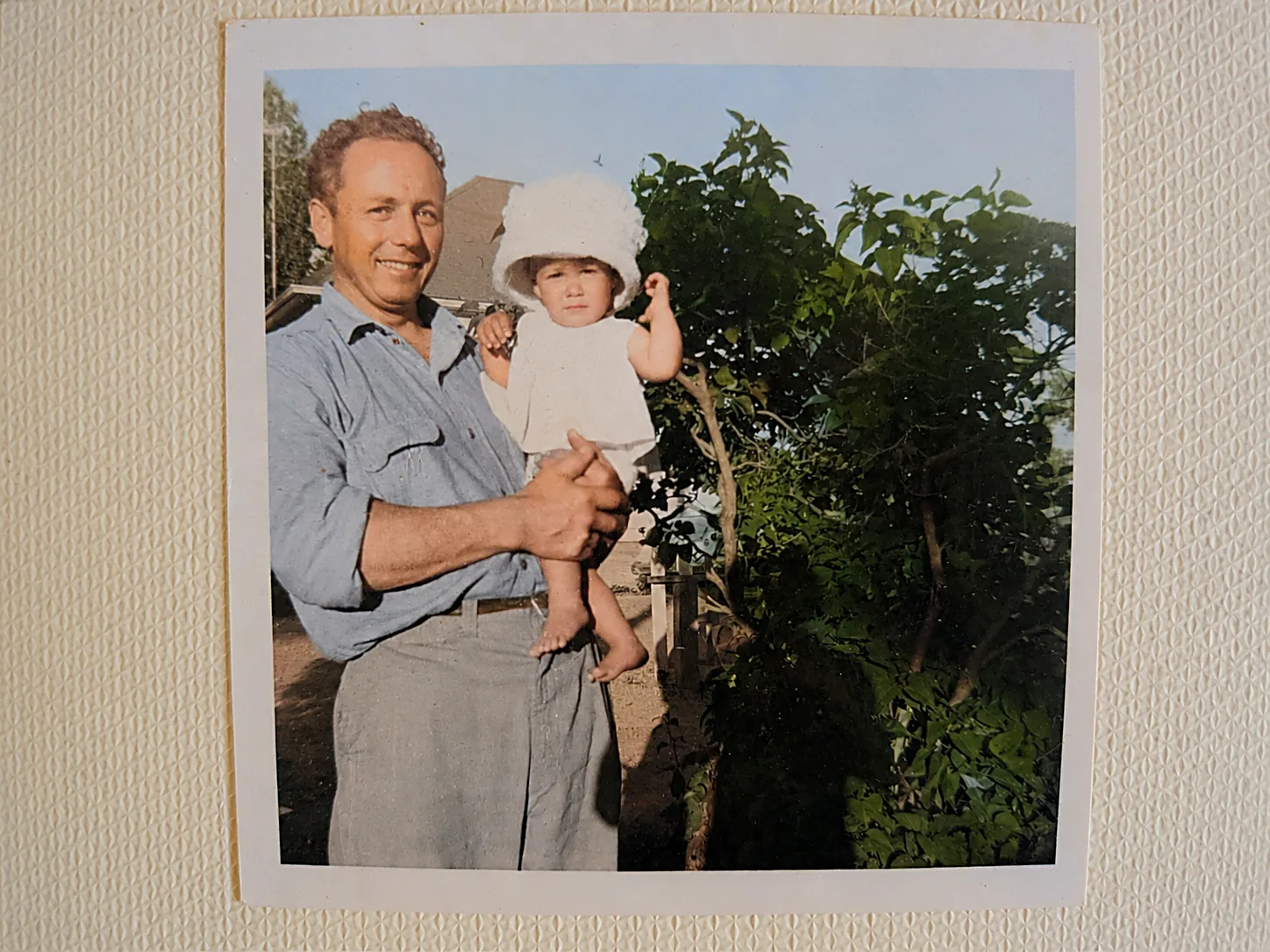
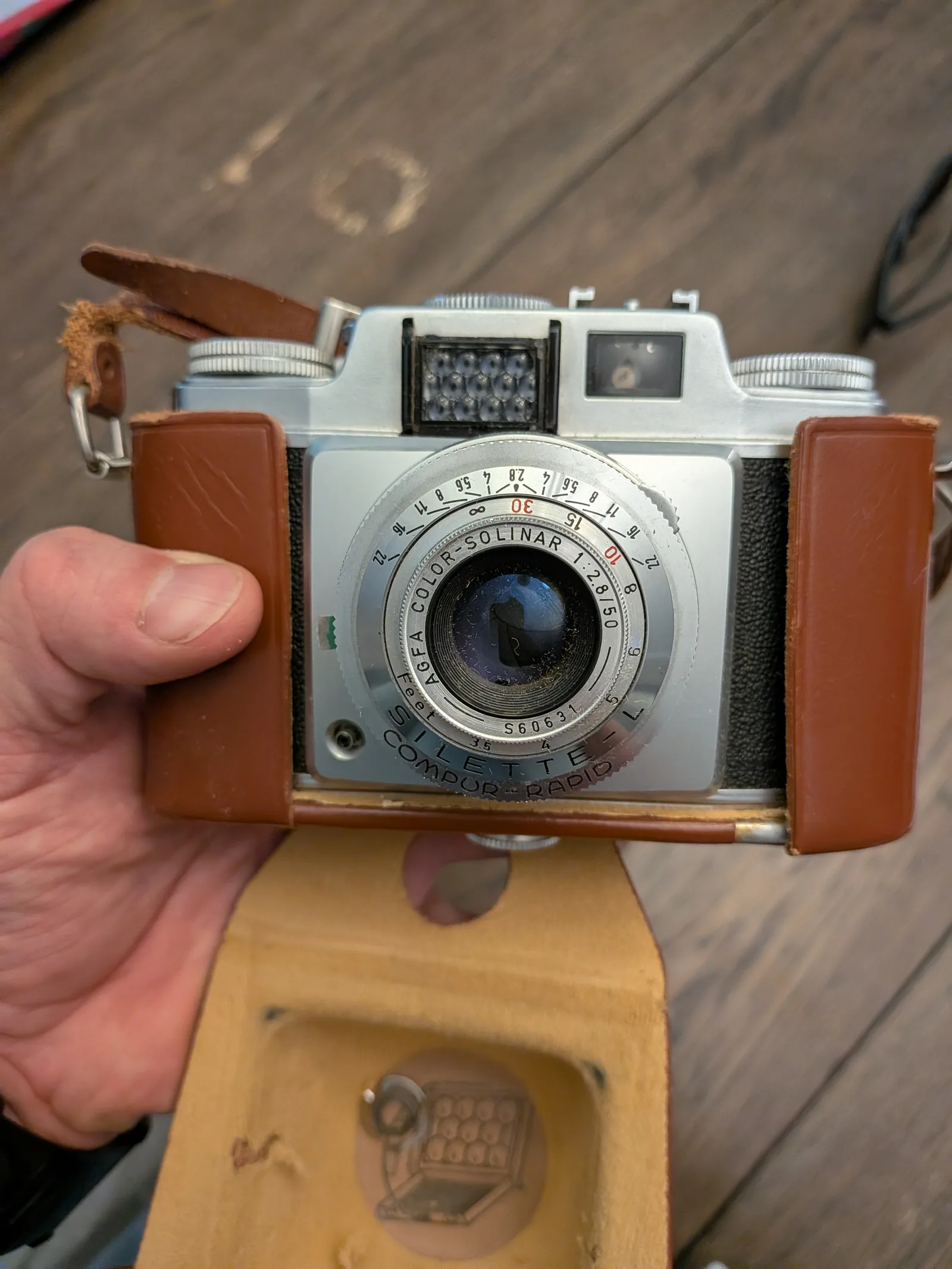
My great-grandfather was a signalman in the Second World War and, it turns out, a hobbyist photographer. This summer I found an album of his with his old camera beside it, the pages captioned in his own hand, the first one headed The Beginning of Army-Life and Married Life. He took the photographs and he kept them, and eighty years on they reached me still in his order. I stood there wondering whether the camera in my hand was the one that took them. That question is the only reason I did any of this. I wanted to see them the way he might have, so I fed them through AI colourisation and tuned each one by hand, because a single filter turns everyone the same waxy orange.
Old photographs have a grammar. Black and white reads as another era, not a fact about film stock but a code we absorb without being taught it, and grayscale holds the past at a psychological arm's length. Colour restores no historical accuracy; the green of a car and the blue of a sky are guesses. What it does is break the grammar. Colour says this could be now.
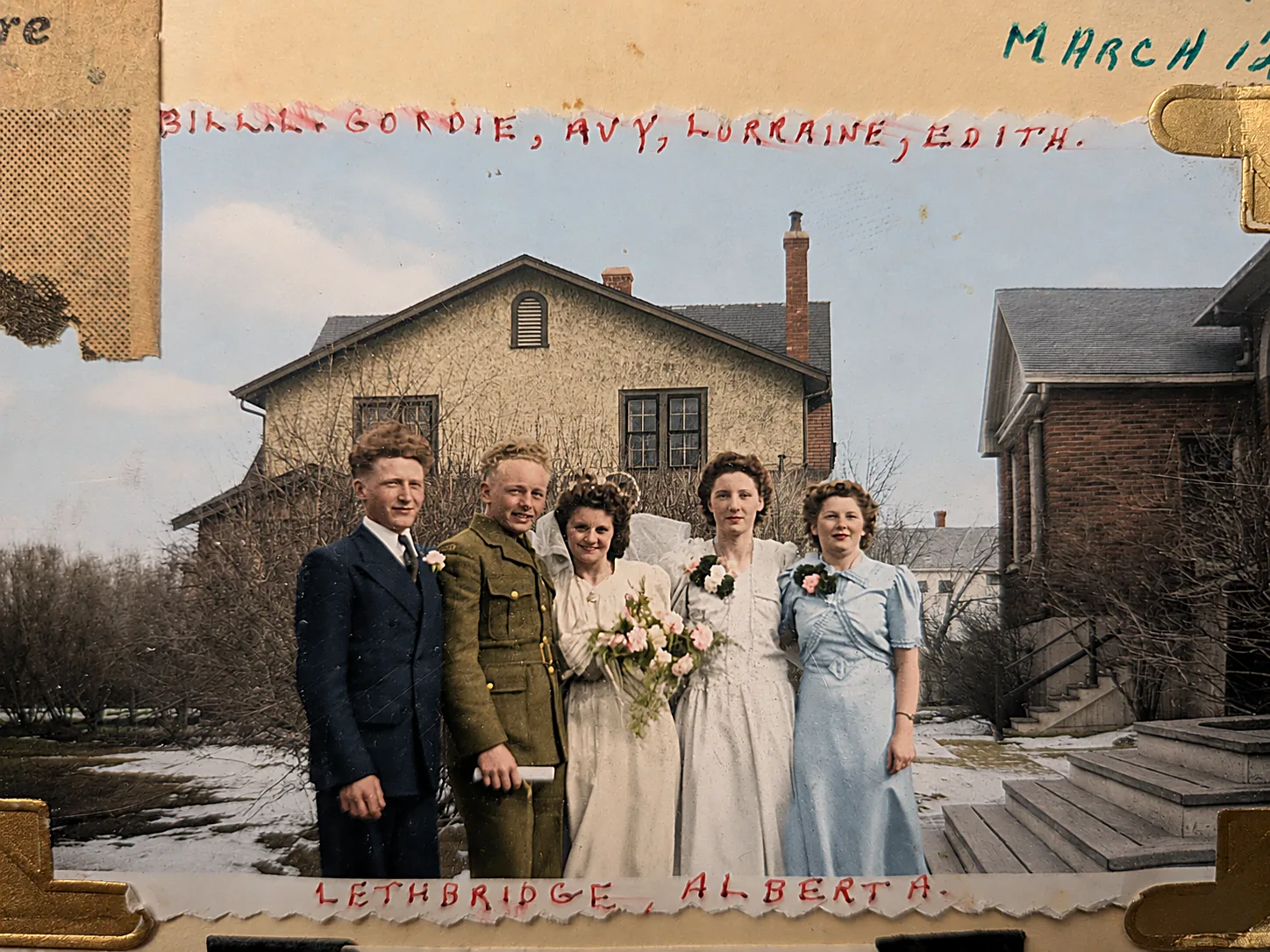
We have more retrievable past than any generation in history and less relationship to it, because abundance delivered the past as shuffleable content instead of a story we immerse ourselves in. Colourising forty-eight photographs by hand was the opposite of scrolling. It walked me back inside the story: my great-grandfather's, my family's, and, it turns out, mine.
I knew this man. My great-grandpa, also a Gordy, was talkative and goofy and loved nothing on earth more than fishing. The photographs show someone I never met: a young man becoming a soldier, then a husband, then a father.
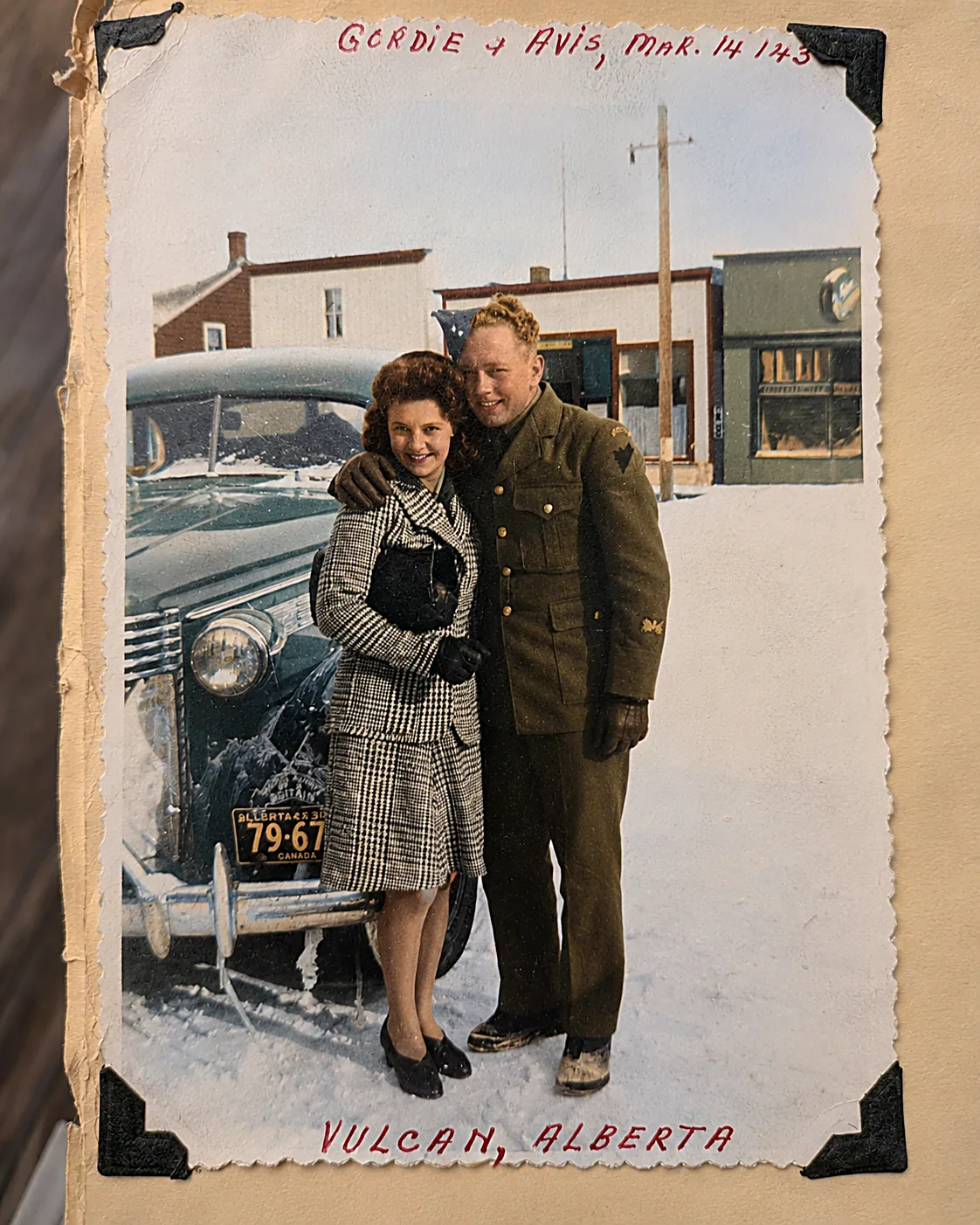
He marries Avis at St Augustin's church in Lethbridge on the twelfth of March, 1943. The newspaper notice pasted into the album puts her in a blue sheer gown and has them leaving that Saturday for Vernon, where he is stationed. Two days after the wedding they stop in Vulcan on the way west, long enough for a photograph beside a green car, snow still on the ground in late March, which is about as Canadian as it gets.
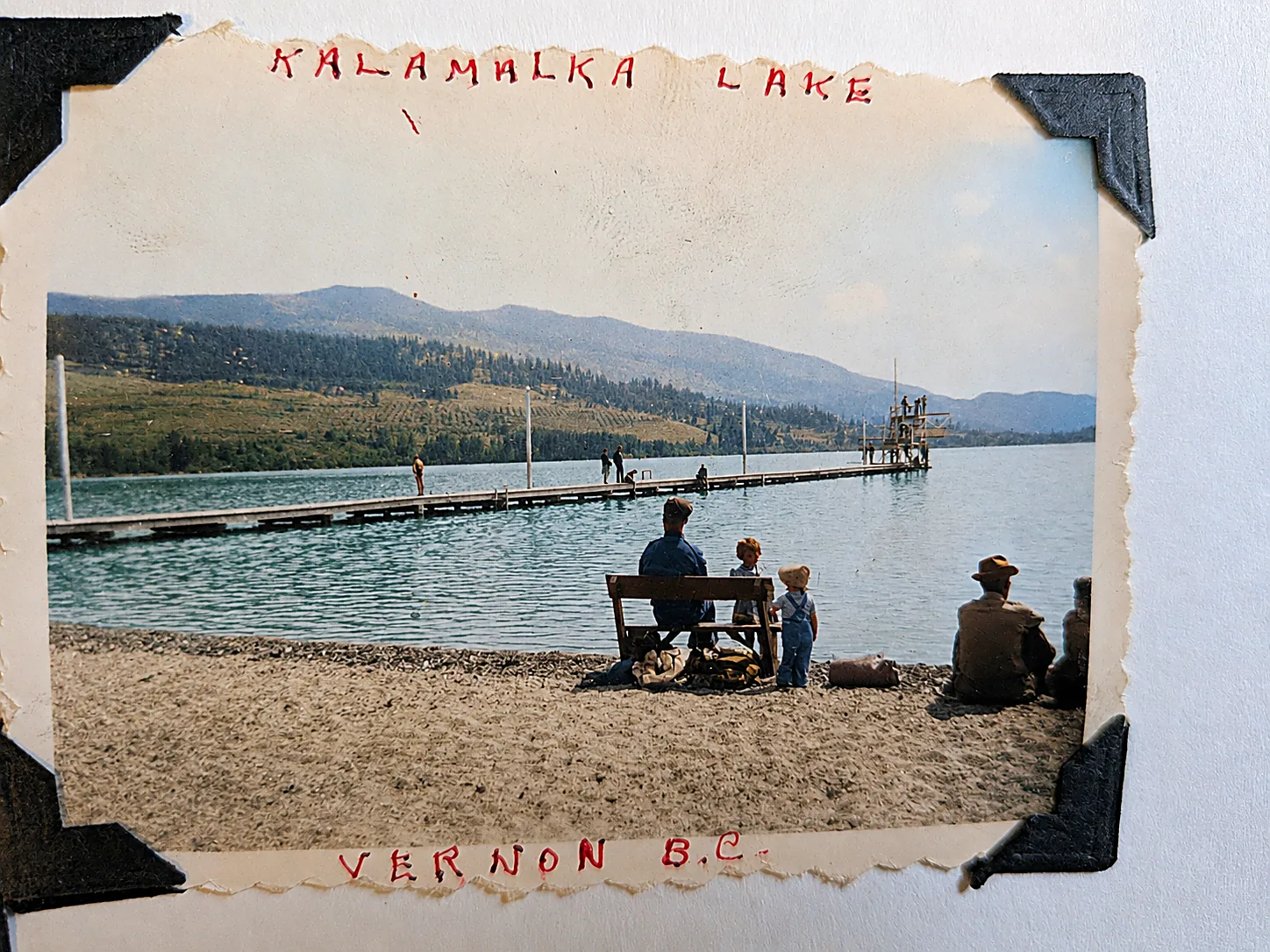
Vernon sits in the Okanagan, twelve hundred kilometres from the church. There is a still afternoon at Kalamalka Lake.
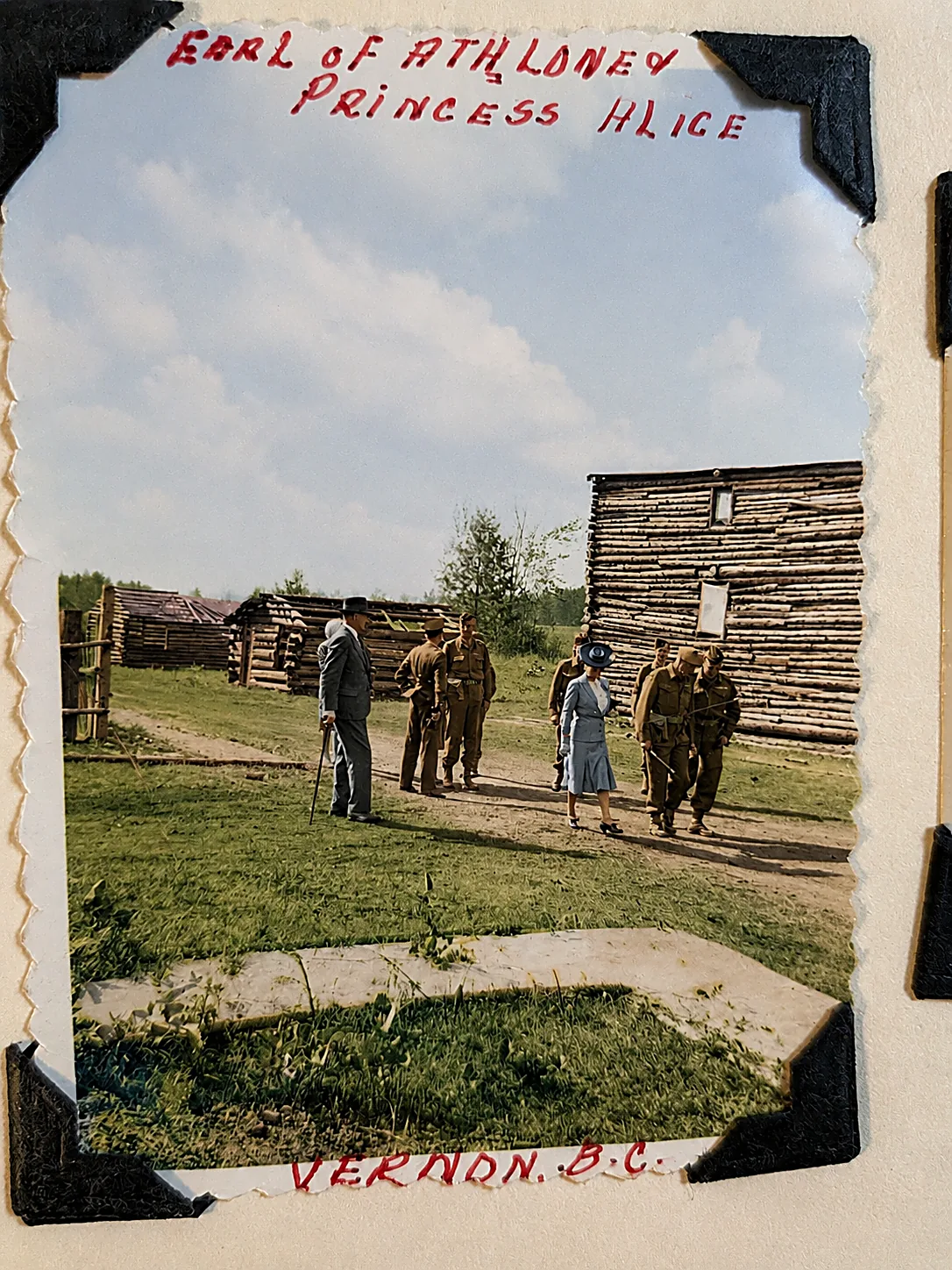
And there is the day the Earl of Athlone, Canada's Governor General, walked an inspection of the camp with Princess Alice, my great-grandfather somewhere in it with his camera up.
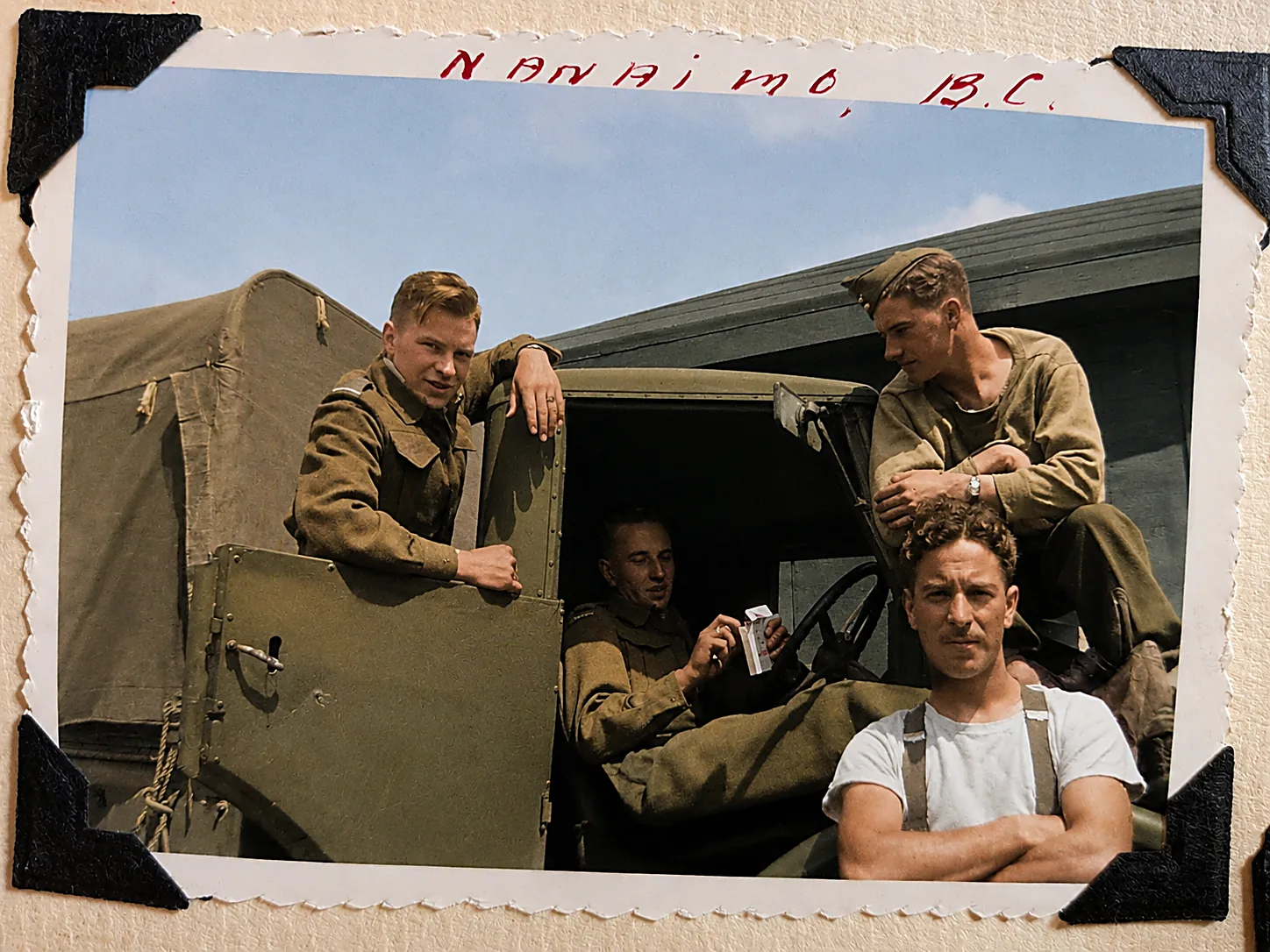
Then Nanaimo, on the island, and the pictures warm up. Men draped over an army truck in short sleeves, squinting into the summer.
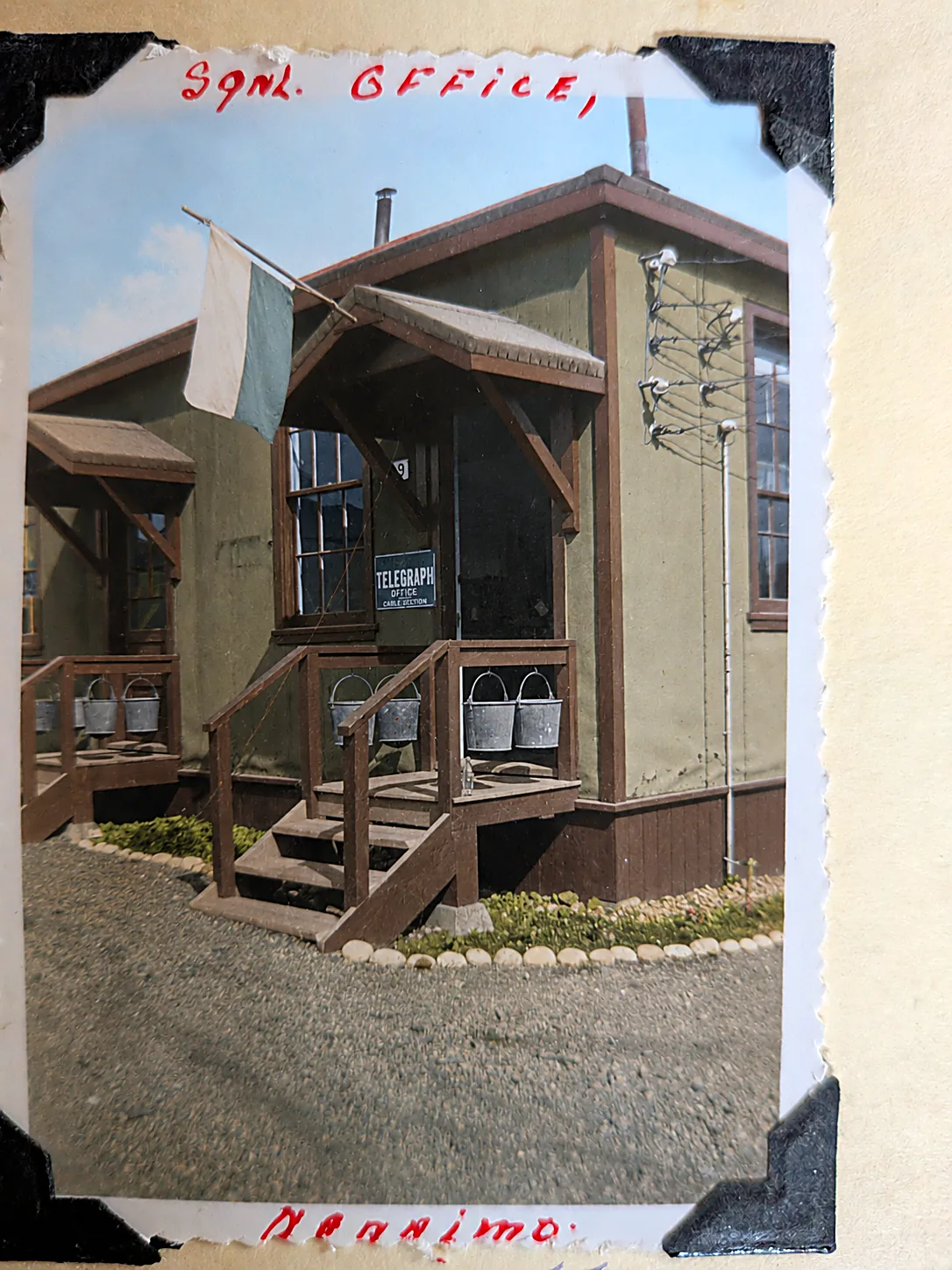
The signal office under its telegraph sign, the closest thing I have to a photograph of the actual job.
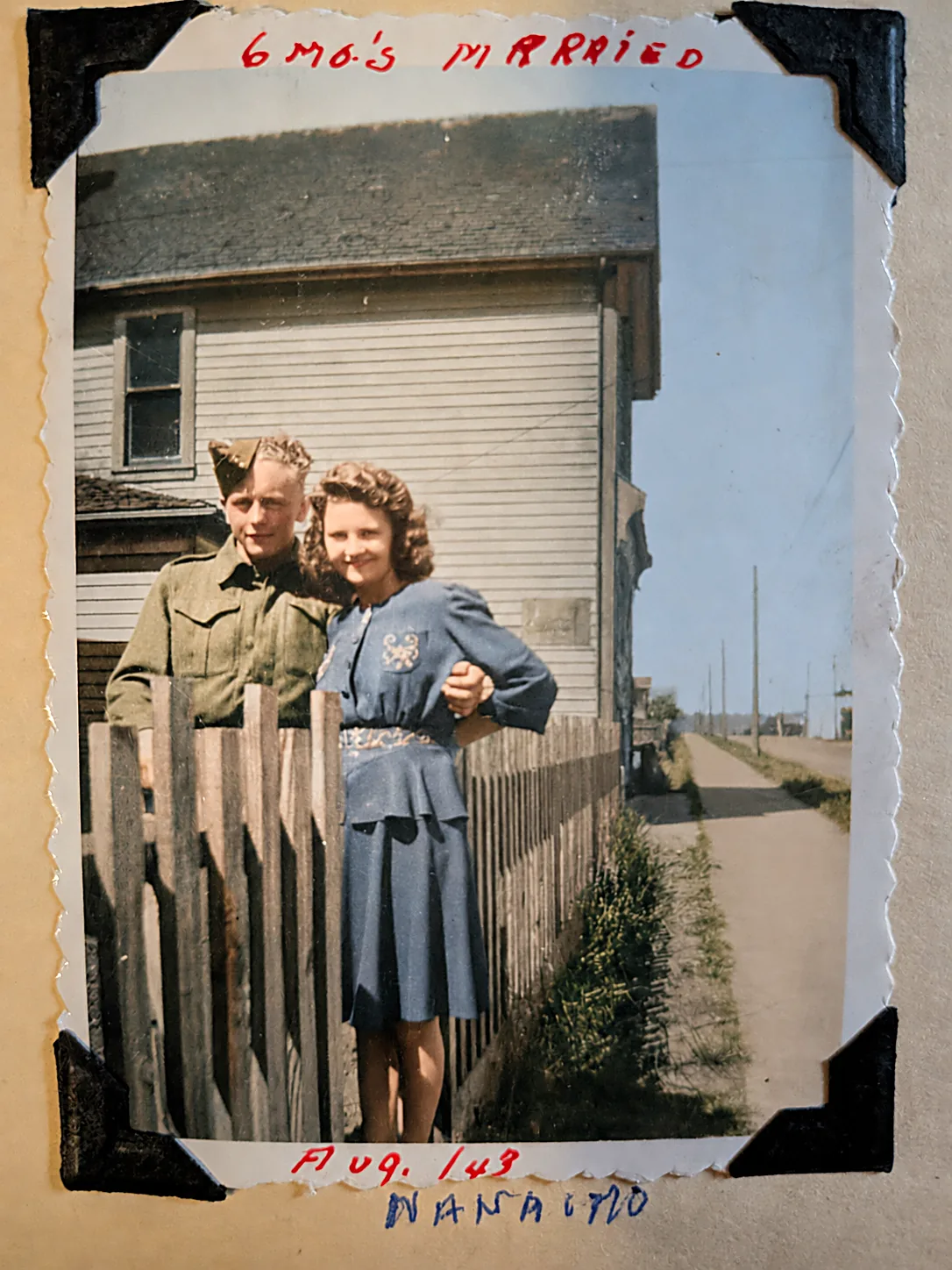
The two of them by a picket fence, six months married, in the August of 1943.
By 1944 he is as far west as the country goes, at a signal office on the wild Pacific edge of the island. At the equipment in one photograph.
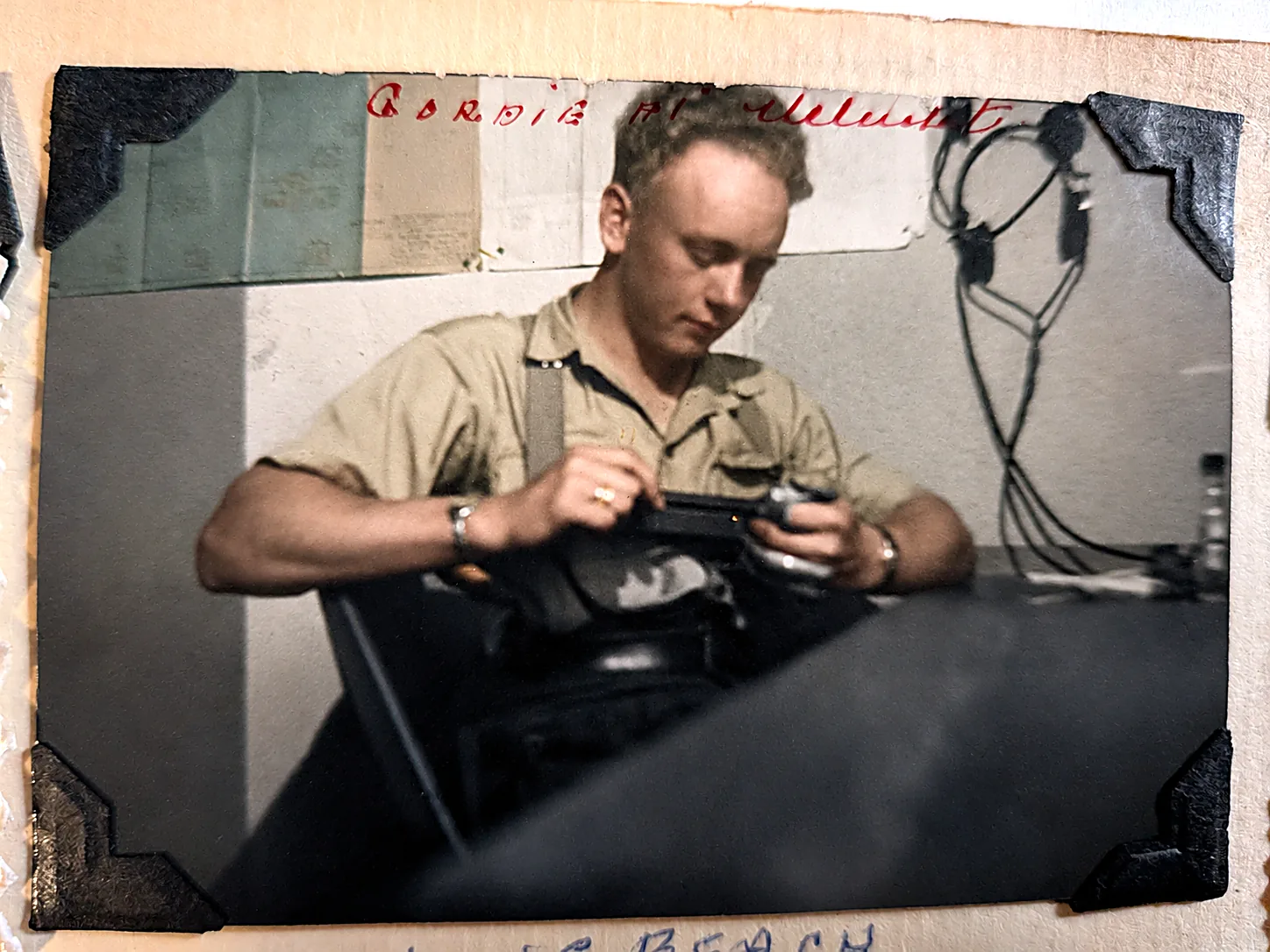
Off duty in the others.
Out on the driftwood with the other men and the coast at their backs.
Then a garden after the war, Gordie older and sun-browned, holding a small boy in a white hat. That boy is my great-uncle Alan. He died last year.
I could only do any of this because I'd spent months being useless. The per-image tuning, knowing which tool to trust and how far to push it, none of it was learned for my great-grandfather. It was learned on dad jokes and dog poop. I even used AI again to place the camera: a West German Agfa Silette from 1955, too late to have taken any of these, which means he kept shooting for decades, and these three years are one small chapter of a much longer adventure.
There's a fair objection to all of this, and under certain circumstances I'd agree with it. AI has a real footprint: water, energy, the compute you can measure. A great deal of use is genuinely wasteful, the same slop regenerated forty times, a frontier model asked to do arithmetic. “Only use AI when you genuinely need it” is sensible advice against that waste, and I'd give it in some rooms.
The trouble is what it rests on. “Only use AI when you genuinely need it” is based on an assumption that trying silly things teaches you nothing. But learning AI is a genuine need, and it runs on silly things. The frame is self-defeating — apply it strictly and you get people who never played, never got fluent, and therefore use AI worse.
We put a score out of five on my dog pooping and then argued about the decimal. That is the trap in miniature. The compute cost of building that tracker is a number too: legible, quotable, easy to feel virtuous about cutting. The fluency it bought me is not. When one side of the ledger is countable and the other isn't, the countable side wins every time. A cost is quick to cut and shows up on the page the moment you do it. The opportunity it kills was slow to build and never shows up there at all. Curbing play doesn't save the planet — it just produces worse users who burn more compute later because they never learned to aim. Efficiency is downstream of fluency, and fluency is downstream of messing about.
You already believe this everywhere else. You've watched play do its work in a kid stacking blocks toward nothing, in your own hands learning a recipe by ruining it first. Nobody tells the kid the tower has to ship. The useless projects are where the capacity for the real work quietly gets built, while you think you're only messing about. The permission you'd hand that kid without a second thought is the one to give yourself: be useless for a while. The point shows up later, unannounced.
Mine arrived as an album with his camera beside it. A poop tracker and a photograph of my great-grandparents by a green car in the Vulcan snow, two days married, March 1943. The same reflex, ten months apart. I couldn't have reached the second without the first, and at the time the first looked like nothing at all.
The waste was the apprenticeship.