I remember my jiu jitsu coach used to have a once a week class that was essentially a learning lab. The days before class he'd study match footage and instructionals for heel hooks, leg entries, whatever was next — and watch until he understood the shape of it. Then he'd grab a training partner and drill it 20 minutes before class started, finding where the mechanics were counterintuitive before the rest of us learned it badly. He came prepared but he also said, out loud, that he was still learning it himself. Those two points may initially seem contradictory, but in his classes they never were.
There are two ways to run a classroom. In the first — your standard English, Science, or Maths lesson — the teacher arrives with a finished map. The territory is already charted; the lesson is the guided tour. In the second, the teacher draws the map in the room, narrating the decisions in real time, marking what's uncertain, handing the pen to someone else when the room knows something they don't. Call the first the Master. Call the second the Workshop Leader.
The Workshop Leader has more going for them than the label suggests. There's a finding, well established in medical education, that people only slightly ahead of their learners often teach better than the experts do — they still share enough of the learner's knowledge state to pitch at the right level. The term for it is cognitive congruence or near-peer teaching.[1] In these unique lessons, my coach was doing a form of that.
Educational systems tend to gravitate toward the first model. We train for it, evaluate for it, and promote on the evidence of it. The second model is harder to credential and easier to mistake for unpreparedness. It is valuable precisely because it does not flatten easily into metrics.
In my second session with a group of AI Champions, I'd planned to go further than the first. I wanted to show them how multi-agent orchestration worked: how you could build chains of reasoning, hand tasks between models, get reliable outputs from deterministic code that no single prompt could generate. I wanted to teach them how to go from a prompt to a pedagogically sound lesson plan and slide deck that conforms to their own style visually and pedagogically, and do it in one shot. I was prepared. I'd designed the examples carefully.
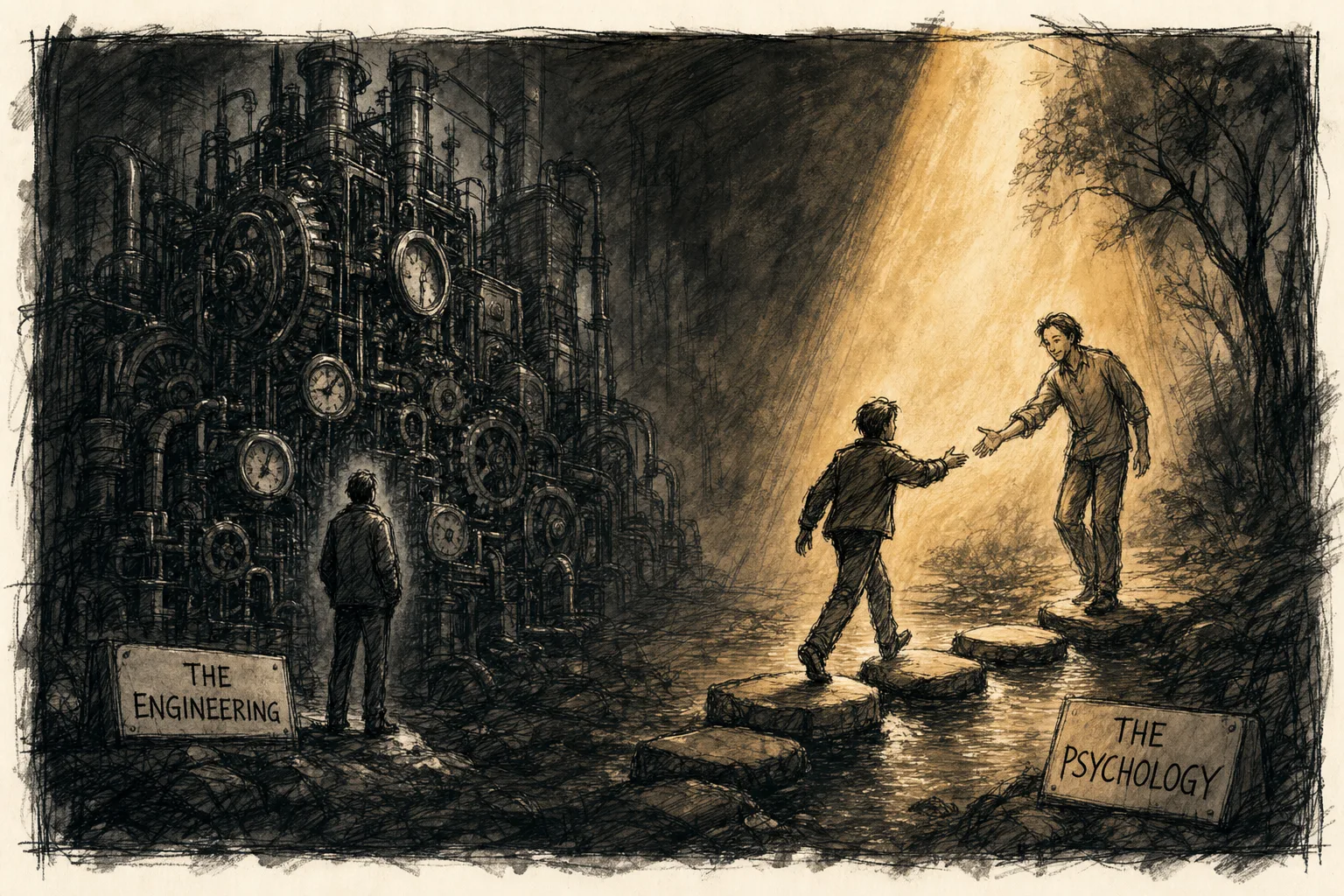
I watched the room move from interest into something closer to intimidation. Not resistance — more like a door easing shut, one face at a time. Two teachers told me, kindly, that “it all seems very useful but I really need to spend more time learning these things.” They were not being disinterested. They were giving me the most honest feedback in the room. The tasks weren't in touching distance; they sat outside the learners' Zone of Proximal Development (ZPD).[2] I'd spent an hour making the room smaller. I'd taken people who walked in curious and, without meaning to, shown them a gap and left them standing on the wrong side of it.
Some of what we call AI adoption is an engineering problem. It's technical, like workflows, tools, and capabilities. The rest, and arguably the more important part, is a psychology problem. It's the anxiety, doubt, and curiosity around whether the next steps feel close enough to take. In session two I spent nearly all my time on the first and skipped the second.
Sessions three and four looked different. The shift wasn't dramatic. The difference was altitude. I came in closer to where people actually were.
One teacher had been creating custom GPTs that were tailored to regional challenges students and counsellors face in applying to university systems that differ widely across the world, getting highly specific advice on admissions processes and personal statement feedback. Another teacher showcased a GPT they used to take the second guessing out of parent emails. We often want them to be perfect and get 90% of the way there only to agonize over a few word choices despite each email being largely the same. Neither of them would have called what they were doing “AI implementation” yet both of them were within touching distance of something significant.
A word I quite like for this is nextpert (thanks Jeremy Utley for introducing me to it) — the person who is one step ahead of the median, not twenty. They're often invisible in professional development because as you formalize a system of development, there are informal channels of knowledge production that get absorbed or flattened. Finding them, and building toward them rather than past them, changes what a room can do.
A survey I ran afterwards showed something I should have expected. Confidence went up across the group. Nobody reported going backward. 75% said they wanted to continue in the peer-sharing format — not the input-and-demonstration model, but the one where colleagues showed each other what they were already doing.
What the second mode of teaching gives you is harder to name than information or skill. It normalises proximity: the sense that being close to something, without being past it, is exactly the right place to be working from.
You can be in the room and still be outside it, if what you're modelling is arrival rather than transit.
He studied the footage in the days before. He drilled it once or twice. He told us he was still learning it, and meant it, because it was true. I'd assumed authority came from distance — from being far enough ahead that no one could see you working. In a larger sense he was, but with the specifics of the class, he was a few steps ahead, and working in plain sight. Giving himself permission to show his work, errors included, gave us confidence to do the same.
References
- [1] Schmidt, H. G., & Moust, J. H. C. (1995). What makes a tutor effective? A structural-equations modeling approach to learning in problem-based curricula. Academic Medicine, 70(8), 708–714.
- [2] Vygotsky, L. S. (1978). Mind in Society: The Development of Higher Psychological Processes. Cambridge, MA: Harvard University Press.