What Happens When You Walk Through AI's Door
I was rehearsing in my empty classroom five minutes before the session when the first person arrived. My immediate thought was: shit, I need those five minutes.
That should have told me everything. I've run plenty of sessions before and there's a feeling I normally get right before they start. Nervous excitement. A "let her rip" energy. This wasn't that. This was mostly just nerves, the kind where you realise you don't know how to begin because although you've prepared, what you've prepared isn't really yours.
I'd used AI to build the whole thing. The structure, the script, the slides, the follow-up questions. I wanted it to land well because I recognised that AI has enormous potential to open these doors for people but I often struggle with communicating ideas that I know to be very valuable. This was the first session of a five-month AI Champions programme I'd designed for my school, and the eight people in that room were colleagues who'd volunteered to help their departments adopt AI. I needed to be credible. I needed to be good. I didn't feel like either of those things.
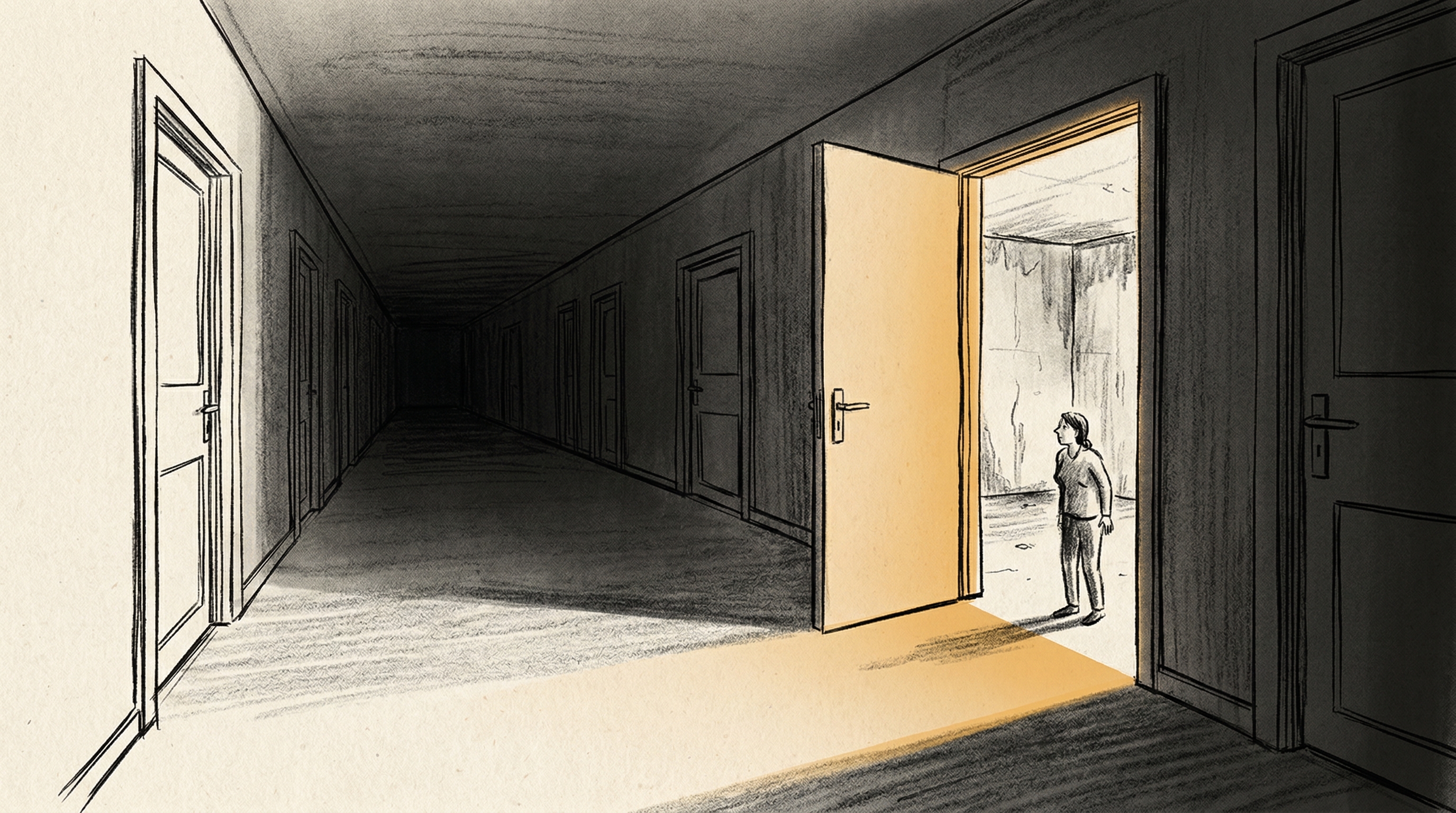
AI opened a door I never would have walked through on my own. Leading adults through a professional development programme was something that a year ago would have died in the shower it came to me in because I usually felt overwhelmed by the workload I already had. The AI planned it, mapped the sessions, built the materials, wrote the script. It made the whole thing look possible. The problem is what happens next. You walk through the door AI opened for you and you're standing in a room you've never been in before. It's dark, unfamiliar, and the thing that got you through the door can't help you be in the room. You have to do that part yourself.
I couldn't do it.
The delivery was stilted. I was toggling between the slideshow and a script, pausing to look up my lines, losing eye contact, losing flow. At some point I couldn't even find where in the script I was supposed to be. The words were polished — minimal, confident, well-structured. They just weren't mine. Delivering someone else's sentences while trying to read the room and seem present is a particular kind of cognitive overhead. You're running a translation layer in real time: converting the AI's phrasing into something you can say out loud while simultaneously monitoring whether people are engaged. You can't do both well. The bandwidth gets eaten. You get worse.
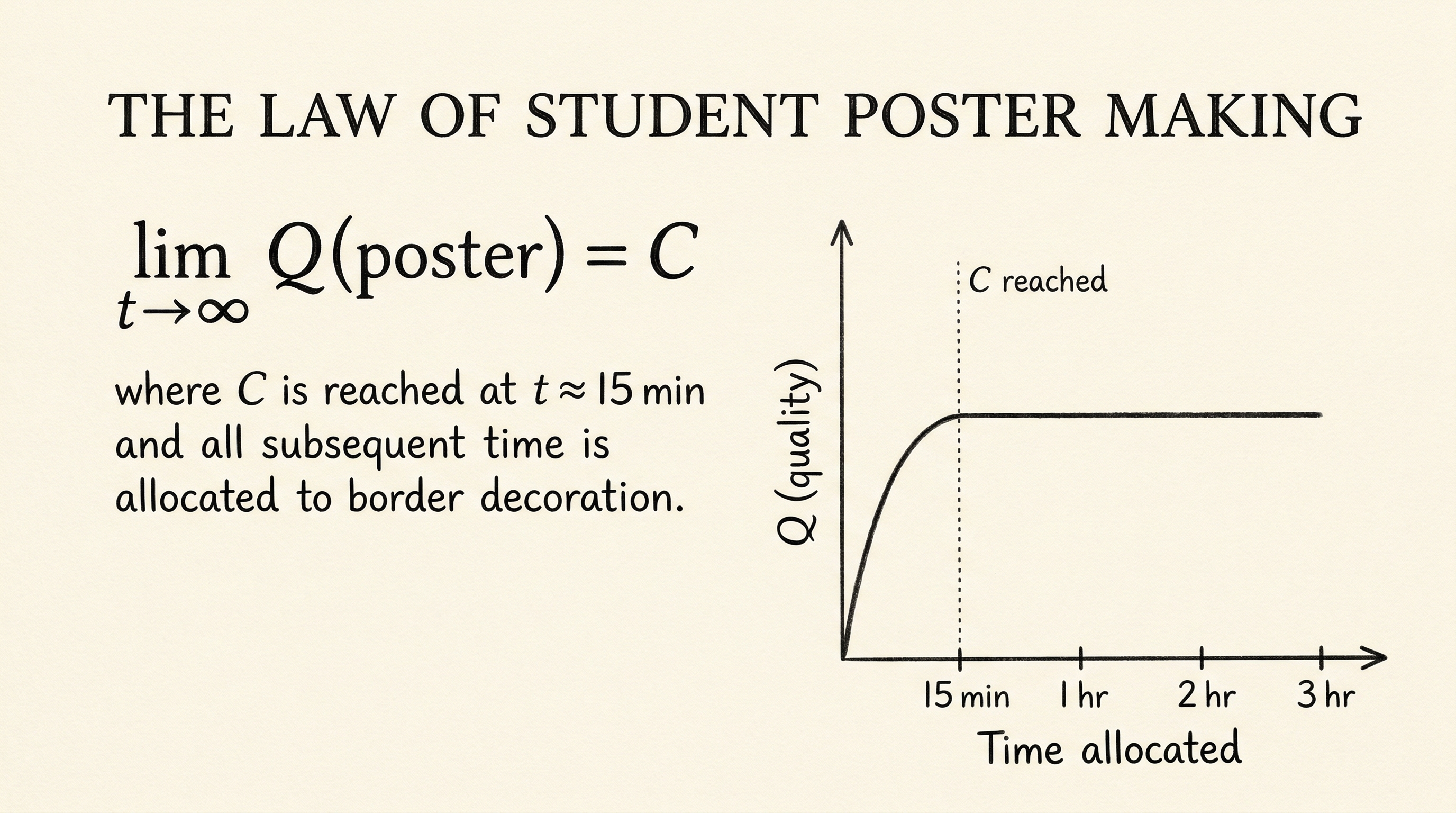
Then something happened. While participants were doing a pair activity, I abandoned the script. I started talking about my own experience back in September when I'd found myself saving four to six hours a week with AI, genuinely free time, and how by November every minute of it had disappeared. The meta-work ate it. The PowerPoint that normally took twenty minutes took forty. The behaviour report that took three minutes took ten. Work expanded to fill the time, the way a poster always takes exactly as long as you give a class to make it.
I got nods. I got understanding because I'd said something authentic.
The middle of the session was much better. People shared how they were using AI in their own practice. A teacher described how she keeps the same AI conversation going across an entire term of lesson planning, training it to understand her teaching style, doing it from her sofa while watching TV. Another explained how they'd scraped 20,000 words of previous emails and used that to generate individualized advice that sounded exactly like them. I riffed off what they said. I asked real follow-up questions. There were moments of actual connection.
The ending was the opposite. I'd burned energy navigating the gap between the script and myself, and by the time I reached the final five minutes I had little left. There was a closing I'd planned — a line about how the whole programme is wellbeing, not efficiency, about getting to do the work that made you become a teacher. It was the anchor for the whole thing, the lynchpin. I never delivered it. In my head I felt like the ending just needed to wrap it up so we could be on our merry way, but in hindsight it's not a wrap up. It's landing a plane, and it's preferable you stick the landing. Instead I said: "Okay, it's 2:35, cookies anyone?"
I also spent ten minutes showing people things I'd built — my website, some AI-generated tutorial videos, a demonstration of NotebookLM — that weren't in the plan. I even caught myself doing it, out loud: "I get a little carried away with the how, sometimes the why is the important thing. Actually, always the why is the more important thing." Hearing yourself diagnose the problem in real time while continuing to cause it is a special kind of frustrating.
The Confidence-Dependency Loop
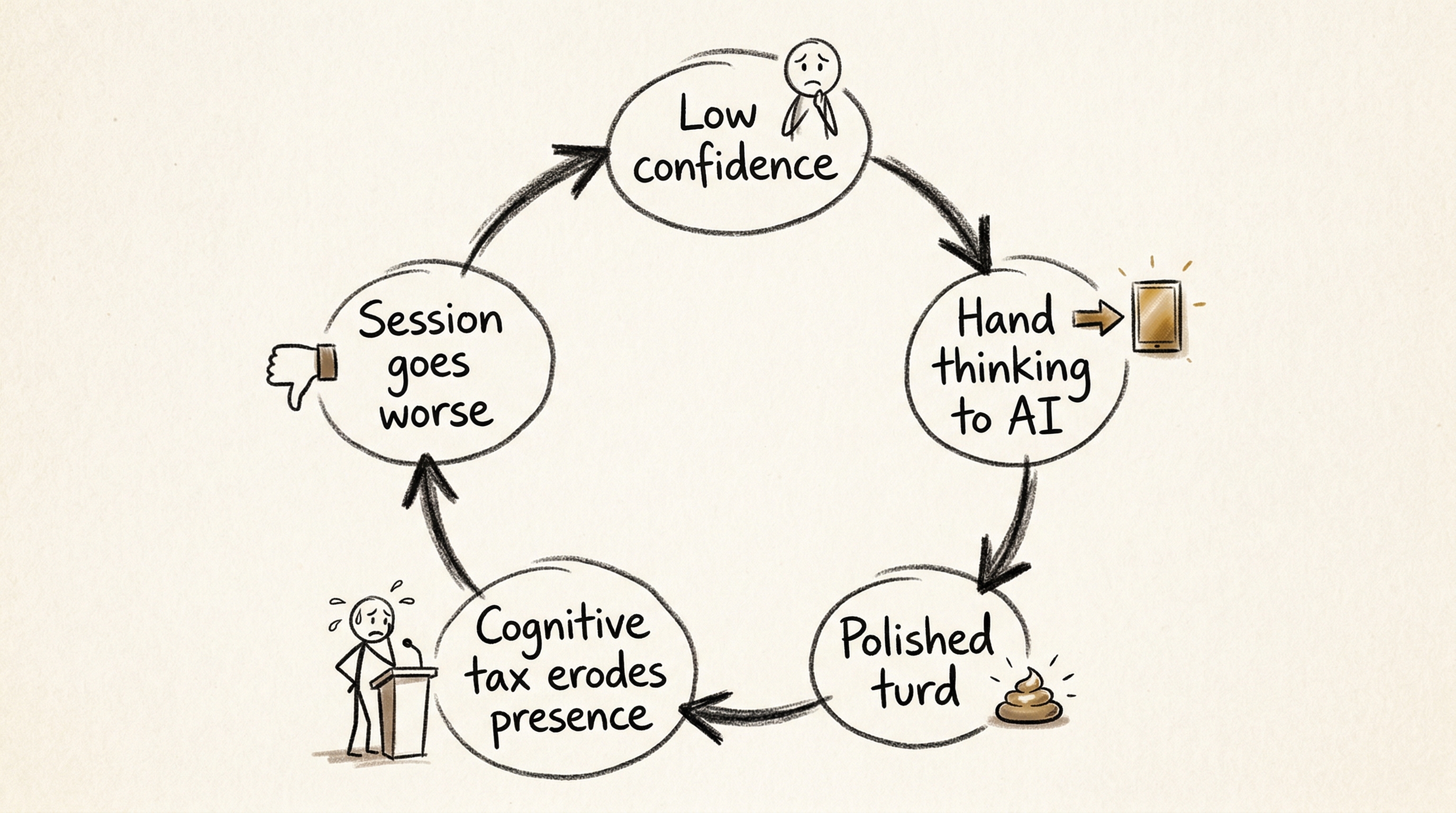
The AI confidence trap: when low confidence causes you to hand more thinking to AI, producing output you can't deliver well, which lowers confidence further, creating a cycle that is hard to interrupt.
Here's what surprised me afterward. The issue wasn't that the session went imperfectly — I expected that, it was my first one. The surprise was discovering that my relationship with AI changes depending on how confident I feel.
In my teaching, in my TOK work, in the tools I build for myself — I argue with the AI. I push back. I tell it what's wrong and make it redo things. I treat its output as a first draft that needs my judgment applied to it. The moment I stepped into unfamiliar territory, that instinct vanished. The AI's judgment suddenly felt more trustworthy than mine.
During preparation, I'd noticed the presentation had no stated objectives at the start. The narrative meandered. I knew these were gaps because I've sat through enough bad PD sessions to recognize the pattern and I knew my audience quite well. I said nothing. The AI had produced something that looked polished, and I convinced myself that my instinct to add more structure was my inexperience talking. Maybe this was how good facilitation worked and I just didn't understand it yet.
My instincts were right and I wish I'd stuck to them looking back.
When confidence is low, you hand more of the thinking to AI. AI gives you something that looks really slick. Pretty soon you are reaching for your black turtleneck and jeans, picturing yourself presenting your slide deck as if you were unveiling the new iPhone. You perform it. The cognitive tax of performing undigested material erodes your presence and effectiveness. The session goes worse than it should, confirming the original insecurity. Thus, you lean harder on AI next time.
The thread that was most worth pulling on for me is what the AI was actually amplifying. AI is an amplifier — I wrote about this before. It multiplies what you bring to it. Bring strong thinking, you get sharper thinking. Bring nothing, you get coherent emptiness. For this session, I'd brought my own thinking to the preparation, but I'd done it in ways that were disorganised and not quite developed enough. There was less for it to amplify. What it amplified instead was the aesthetic of competence — clean slides, tight scripts, elegant structure — without the substance of having actually digested the material. The output looked like the real thing but I felt like two kids standing on each others shoulders in a teacher suit pretending to be one.
The Plan Is Not The Thing
Safety Net vs Substitute
Something did work, though, and the distinction matters.
The share-out activity where participants described their "excellence versus friction" areas went well. AI had designed the activity and suggested follow-up questions. I had them as a backup. Even when I didn't use them, knowing they were there freed me to actually listen and respond naturally. The questions worked as a safety net: they left room for me to show up. The script worked as a substitute: it took up the space where I was supposed to be.
AI as safety net: You do your own thinking, prepare your own material, develop your own understanding, and use AI to catch what you missed. You free yourself to expand your thinking to new areas you didn't have the cognitive space for before.
AI as substitute: You skip the thinking entirely and perform the AI's output as if it were yours. The first approach has room for you in it. The second doesn't.
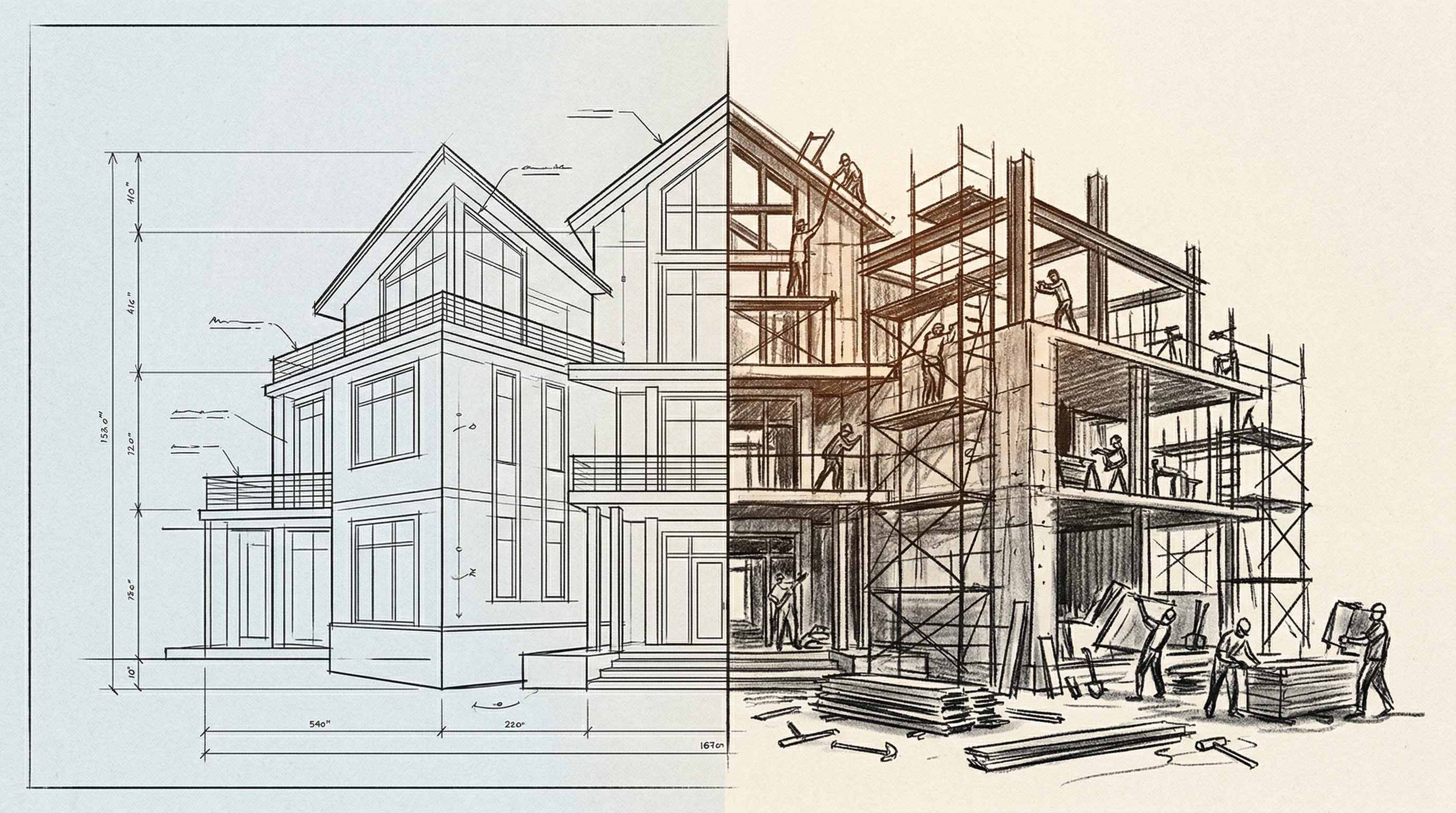
Katie Parrott at Every called what I experienced afterward the never-done machine — the phenomenon where AI doesn't reduce your work, it makes you want to do more of it. The save-four-hours-then-lose-them-all cycle I described to the group. I'd add something she doesn't quite name: the never-done machine also applies to preparation. When AI can always make your slides better, your script tighter, your structure more elegant, you never feel done preparing. You chase polish because polish is what AI is good at generating, and the preparation itself starts to feel like progress. The problem is that polishing a turd is still polishing a turd. Material you haven't digested doesn't actually prepare you. It just makes the turd shinier.
There's a difference between a thought leader and a thought doer. A thought leader publishes a framework. A thought doer restructures a team around it and reports back on the ugly parts. AI has made the first one trivially easy. A few well-prompted queries and anyone sounds credible. The second one still requires you to have actually been in the room.
I want to be the thought doer. I'm building that programme. I want to do the real work of helping colleagues figure this out. For this one session, I slipped into thought leader mode without realizing it. I let AI give me the surface because I didn't trust my own substance.
What to Do With That
I've been thinking about what I'd tell someone who's in the position I was in: using AI to open doors to new rooms they otherwise never would have entered. Building things they've never built. Leading sessions they've never led. The door is real. AI genuinely opens doors that would otherwise stay closed and you should walk through them.
The thing to watch for is what happens once you're inside. The temptation is to keep leaning on the thing that got you through the door. The AI planned it, so the AI should run it. The AI structured it, so the AI's structure must be right. The AI wrote the words, so the AI's words must be better than mine. Each of these feels reasonable in the moment and each of them removes a piece of you from the work. It removes your thisness, your authenticity.
The middle ground I reckon looks something like this. Do your thinking first. Feel the discomfort of not knowing exactly what to say. Sit with the uncertainty of being new at something. Then bring in AI to help you say it better, structure it better, catch what you missed. Start from your own ideas and let it sharpen them. The blade has to be yours. AI can hone it but it can't swing it for you.
There'll be more for it to work with.