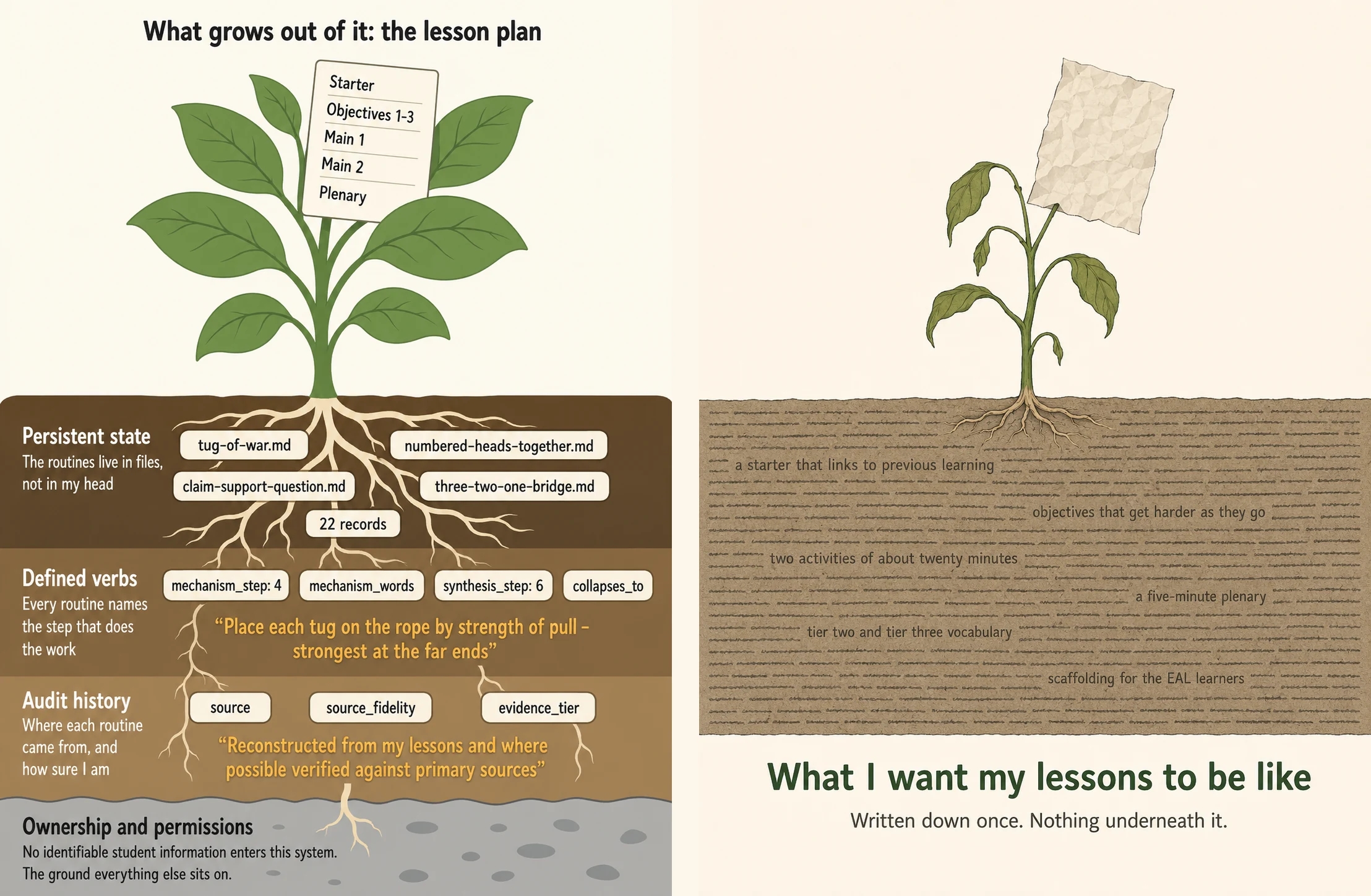
The third tool I've made with AI that I want to test against Claude for Teachers is a skill I call the Lesson Improver. It does what it sounds like: I feed it lesson material and it helps me improve it. It's the third verdict in a series on whether Claude for Teachers can replace the tools I've built by hand.
I built it because of how my lessons tend to start. Usually it's a provocative question, a controversial current event, or something I've noticed my students aren't quite there with yet. Recently it was an article about some unethical AI research run on an unwitting subreddit. From that seed I have to work backwards to a complete lesson, and for me a complete lesson looks a particular way.
Generally: a starter activity, ideally one that links to previous learning. Clear objectives, arranged so the first is easier to reach than the second or third — a recall or name objective is a lower bar than evaluate or synthesise. For a fifty-minute lesson, two main activities of roughly twenty minutes each, then a five-minute plenary. Around that sit the things that are easy to drop: tier two and tier three vocabulary, support for English-as-an-additional-language learners, extension work, differentiation. Sometimes I want an alternative version that runs outside, or with minimal devices.
That's the target. The problem is that reverse-engineering all of it from a seed takes time I often don't have. Some weeks I've got forty-five minutes to build the lesson, and things go missing. What saves you is that as a teacher you can usually see what those elements would have looked like even when they aren't written down, so you freestyle the gaps, which is also what lets you adapt the lesson while you're teaching it. The Lesson Improver exists to make sure I'm actually doing the things I already know a good lesson should have, rather than trusting myself to improvise them at the end of a long week.
How it runs
It runs in about eight steps, starting at zero. Step zero exists to bypass the skill: if the lesson already has everything I've said a good lesson should have, it stops there and tells me, rather than reinventing a wheel that's already round.
Then it loads. One file describes the subjects and levels I teach. Another is the substrate — a database of lesson activities I've built up over time. These are thinking routines: small repeatable activities I've used successfully and can explain to any teacher, or to an AI with none of my context. Things like Plus One, Circle of Viewpoints, Tug of War. It then inventories what the source lesson already contains, which is what stops a working activity being quietly overwritten.
From there it runs a checklist. Is the opener retrieval or recap? Generative or recognition? Is the vocabulary front-loaded? Is the scaffolding faded appropriately for the year group? It picks the tier two and three vocabulary. Then a devil's advocate pass argues against its own recommendations on context, implementation cost and a few other grounds.
At that point it loops me in to approve or edit the plan. That plan will contain routines I trust and usually one or two I don't reach for as often as I should, which is useful. I'm regularly adding to the database as I re-teach old lessons, or come across another teacher's material that introduces me to something I like.
Once I approve, it builds. The plan is written as markdown and compiled into a Word document, capped at 1,250 words. The slide deck, if there is one, is generated from that plan. Step seven validates the outputs — objectives, exit ticket, vocabulary, structure. Step eight is the final report, which I review.
What's actually underneath it
The most useful part of this skill came from Nate Jones, who argues that a tool becomes usable as infrastructure for an AI agent when it has five structural properties: persistent state, defined verbs, ownership, permissions and audit history. Two of those exist to stop agents colliding with each other, and there's one of me, so ownership and permissions don't transfer. The other three are the whole reason this works.
Persistent state, or as he puts it, records rather than content. My routines aren't paragraphs describing an activity; they're files with typed fields. Which step carries the cognitive work. What words must appear in the instructions. What the routine will degrade into if you let it.
Tug of War is the clearest example. It's easy to treat it as a way of listing arguments for and against, but the evaluative moment is the point: students place the arguments they find more convincing further along the rope. Drop the placing and you have a stand-where-you-stand debate. My record says the mechanism lives in step four, gives the wording that has to survive into the instructions, and names what you get without it.
Defined verbs are those field names doing work — mechanism_step, mechanism_words, collapses_to — rather than a paragraph of good advice. Audit history is the field on every record saying where the description came from and how confident I am in it. Nine of the twenty-two are verified against the source text, eight are verified for the procedure with something reconstructed around it, and five — Tug of War among them — are reconstructed from consistent secondary sources and say so on the record.
The verdict
These tools were never about the strength of the model. They're useful because of what the model is built on top of — the substrate, and the harness around it. I think if I took this exact skill with the substrate I have now back to summer 2025, I'd get lessons of almost unnoticeably different quality.
Anthropic appears to agree. They open-sourced the lesson-planning skill behind Claude for Teachers, so I read it. It sits on a queryable knowledge graph (AKA a substrate): ask for a standard and you get the prerequisite standard beneath it, the sub-skills it breaks into, the misconceptions students reliably bring. Their instructions call it a critical failure to skip that lookup. They publish thirty-four scoreable criteria as a public CSV so anyone can mark their homework.
Their skill also names no pedagogical routines. Not Think-Pair-Share, not Jigsaw, not Tug of War. Probably for sound reasons — describing someone else's routines inside a commercial product is a licensing question before it's a design one. It's still not there.
Those are two different facts about teaching, running in different directions. Theirs runs vertically, down through the curriculum: what this lesson should cover, what came the year before and the term after, what students get wrong about the content. Mine runs horizontally, across the inside of one lesson: given that you've chosen an activity, which step makes it that activity, and what it becomes without that step. Neither contains the other. A plan can be flawlessly standards-aligned and still be a Tug of War with no evaluative thinking whatsoever.
So: matched on their axis, missed on mine. And the thing worth taking from it, if you're building your own, is that what will make yours irreplaceable or not will be how much of you, your experience, and your expertise is layered into it. It's about whether the thing underneath your model has records or just content.