Most Septembers, including this one, I have the same two conversations, usually a few weeks apart.
The first is with families whose child is just starting the IB Diploma Programme. They want to know what the programme offers, whether it is the right choice, whether their child is in the right place. Underneath the questions there is a sense that they are being asked to predict a future for their 16-year-old.
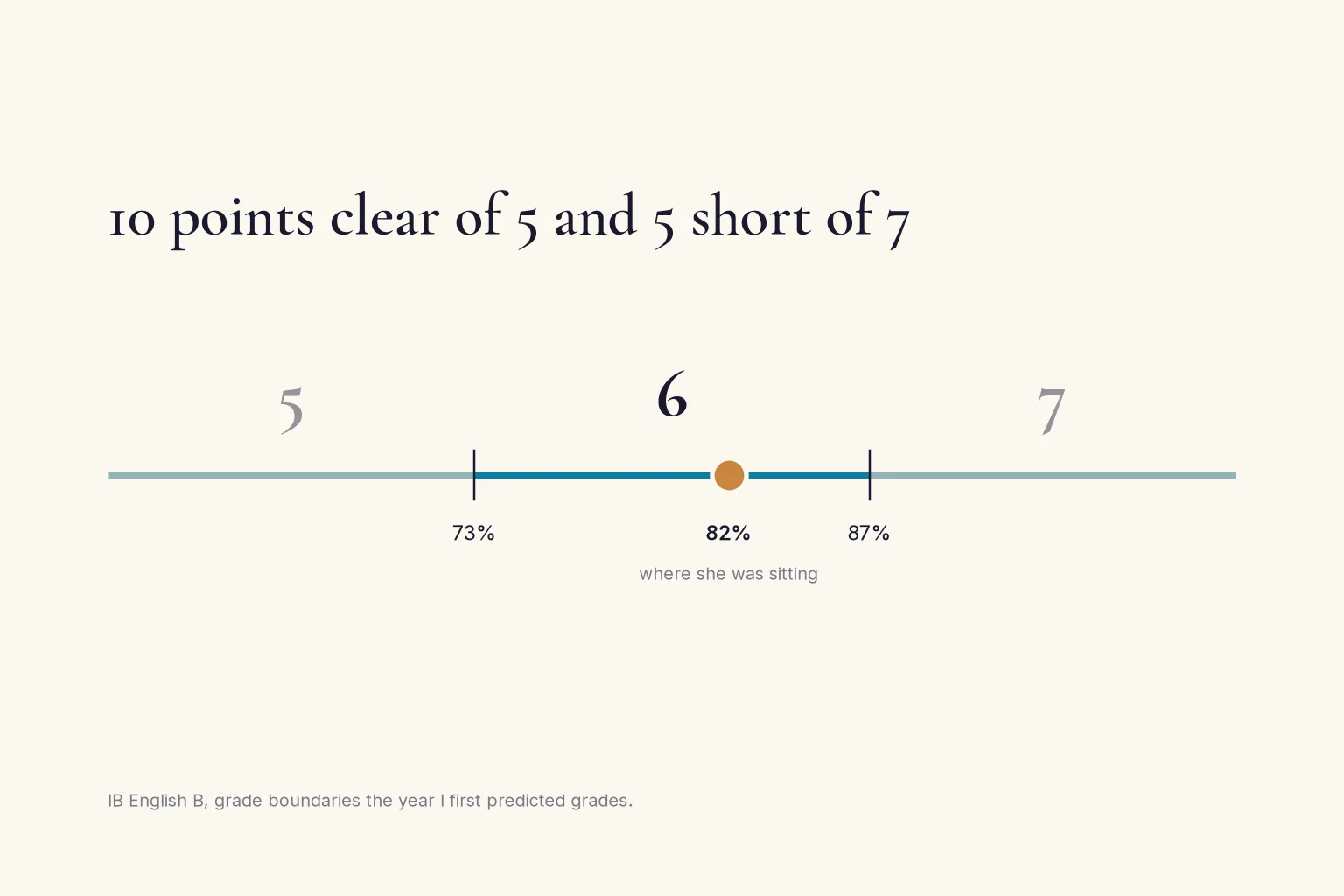
The second is with Year 13s who have started their university applications. That one is about predicted grades, and it has become strategic in a way I find difficult to argue with. A student who is not predicted an aspirational score can reason their way to the conclusion that there is no longer much point working hard. What really bothers me about this is that the reasoning, at least ostensibly, holds. I remember my first time predicting grades for an IB student. She was sitting around 82% and the boundary for a 7 in English B was 87% while the boundary for a 6 was 73%. I followed the guidance of my department and told her I was predicting her a 6. She responded that she understands, but that she will reduce her efforts in class because she's comfortably above a 6, not going to get a 7, and needs to invest time in classes that have predicted her higher than her current score.
These are two rather similar conversations. Both students are waiting on a verdict that someone else will issue later, and both have tacitly accepted that the verdict is the thing worth having.
There is a third conversation, and it does not happen in a meeting. It happens after class, when the room has emptied and someone has stayed behind. In a hallway. On the way out of the building at the end of the day.
What the student says, in various forms, is that their friends seem to know. They know what they want to study, where they are going, what the plan is. So this student feels they ought to know as well, and they do not, and the gap reads to them as falling behind.
The three do not obviously connect, and in the room they do not. What they have in common is the yardstick. Each of them is measuring the programme against whether it has produced a calling yet, one thing to go off and pursue, and it was never built to do that. The whole point of a generalist education like the IBDP is that you are optimising for opportunities, not for "optimality". It is a strong choice for a wicked environment, the kind that will not tell you in advance which of the things you are learning are going to count.
I have an answer for all three. I have had it for years. And I think my answer has generally missed the mark because in my aims to be helpful I am trying to logic them out of a feeling.
What I am actually doing
In these situations I tend to reach for the research.
What I am trying to show them is that the situation is not as black and white, not as linear, as it looks from the inside.
The thing they are missing is not value. It is certainty about value. Most of them can see that what they have chosen to study is worth something. They cannot be sure of it yet, and that is a different problem, and only one of those two problems can be solved by talking.
Value is easier to see backwards than forwards. None of us are good at predicting our own futures. We are all reasonably good at explaining them afterwards, which is not the same skill and does not arrive in time to be useful.
The part I had wrong
For years I have told students that the world the school system was built for does not hold any more because people do not stay on one path. They change jobs, they change fields, they change what they are. Do not narrow too early, because the environment you are preparing for is not a stable one.
I was about to trot out that same line of reasoning in this blog, but I thought such a claim surely will have a plethora of evidence, so I checked it.
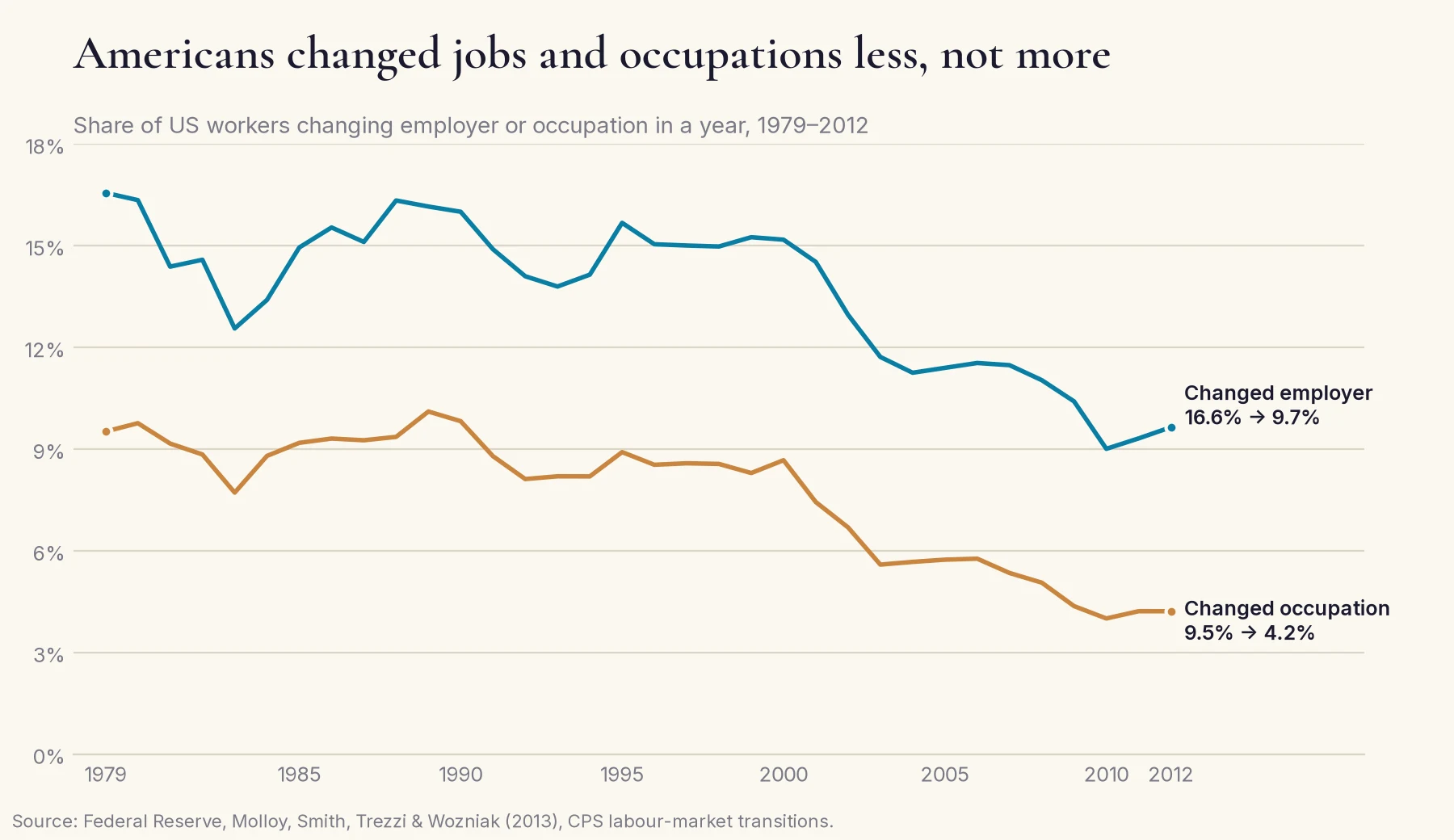
I use AI for initial research now. It does speed things up, though not because I take what comes back at face value. Vetting what it returns takes less time than doing all of the research myself. It is also helping me falsify things I had rather believed to be more convincingly true than they were. This was one of them. The claim went out to be checked and came back the other way round. People are not changing jobs more. Across employers, occupations and regions, mobility has been falling since the early 1980s. Annual occupation change roughly halved between 1979 and 2012. The series stops in 2012. The years since have not turned it round: there was a jump in 2021 and 2022 when it seemed everyone was quitting, and by this summer the quit rate was lower than before the pandemic.
And the statistic you have probably seen clogging up the tubes of the internets, the one about how many careers you will have in a lifetime, is disowned by the agency it gets attributed to, which says plainly that it has never attempted to estimate that number at all.
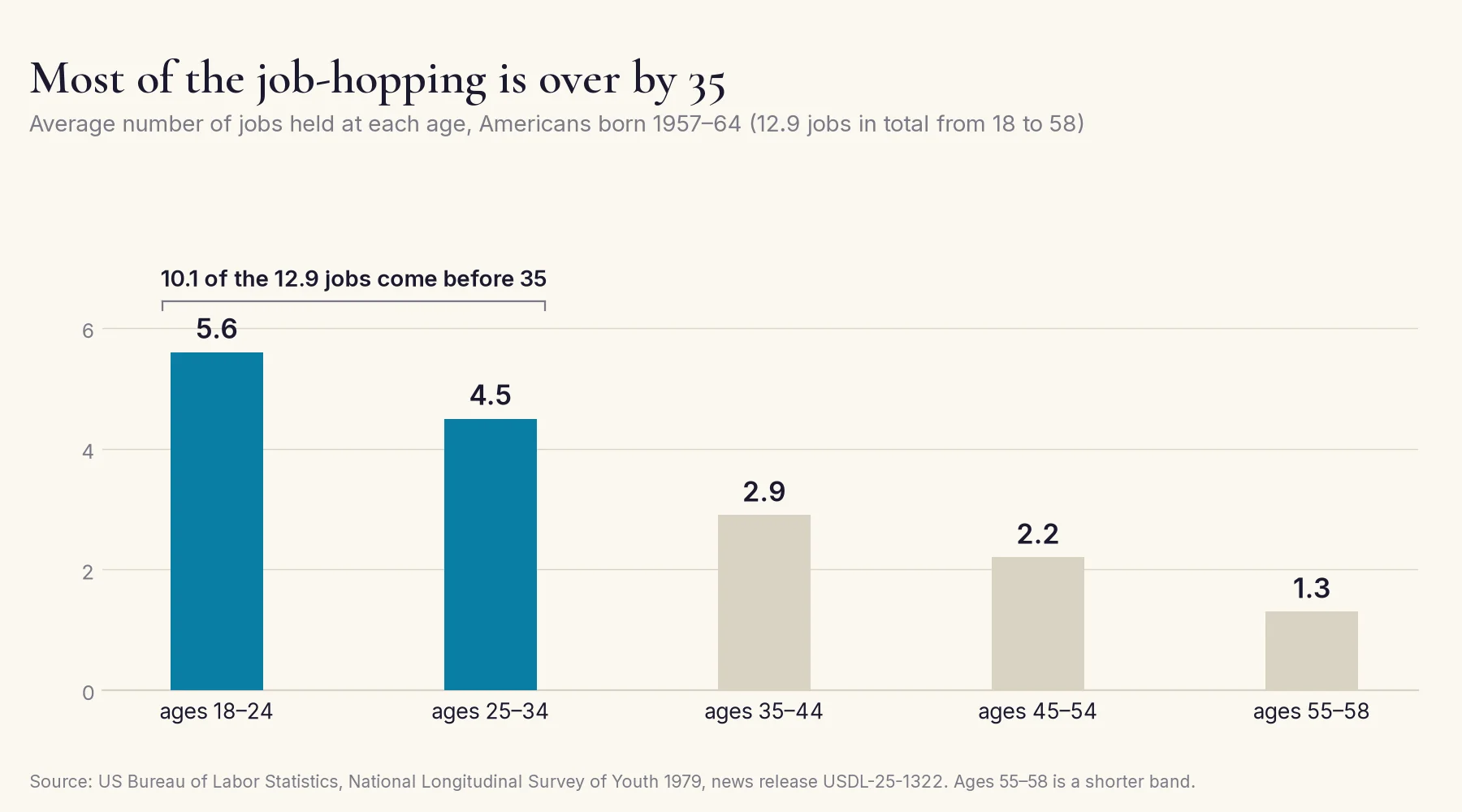
I had been telling students something true-sounding and unchecked for years, on the back of “research” I had heard or seen somewhere and not bothered to question. Not a very good TOK moment.
Here is what survived, and it is the thrust of it. The advice I still reckon is right but the reason was wrong.
What has changed is not that people move between jobs more. It is that the job changes around the person who stays put, and this is becoming more true with AI. A pre-registered field experiment with 776 professionals at Procter & Gamble found that people working without AI stayed inside their own function, with the R&D specialists proposing technical solutions and the commercial specialists proposing commercial ones. The people working with AI produced balanced solutions regardless of what they had been trained as. This isn't someone changing jobs, but it is a blurring of the roles. It shows the boundary of what one person can do inside a role moving while the person in the job isn't changing titles or professions.
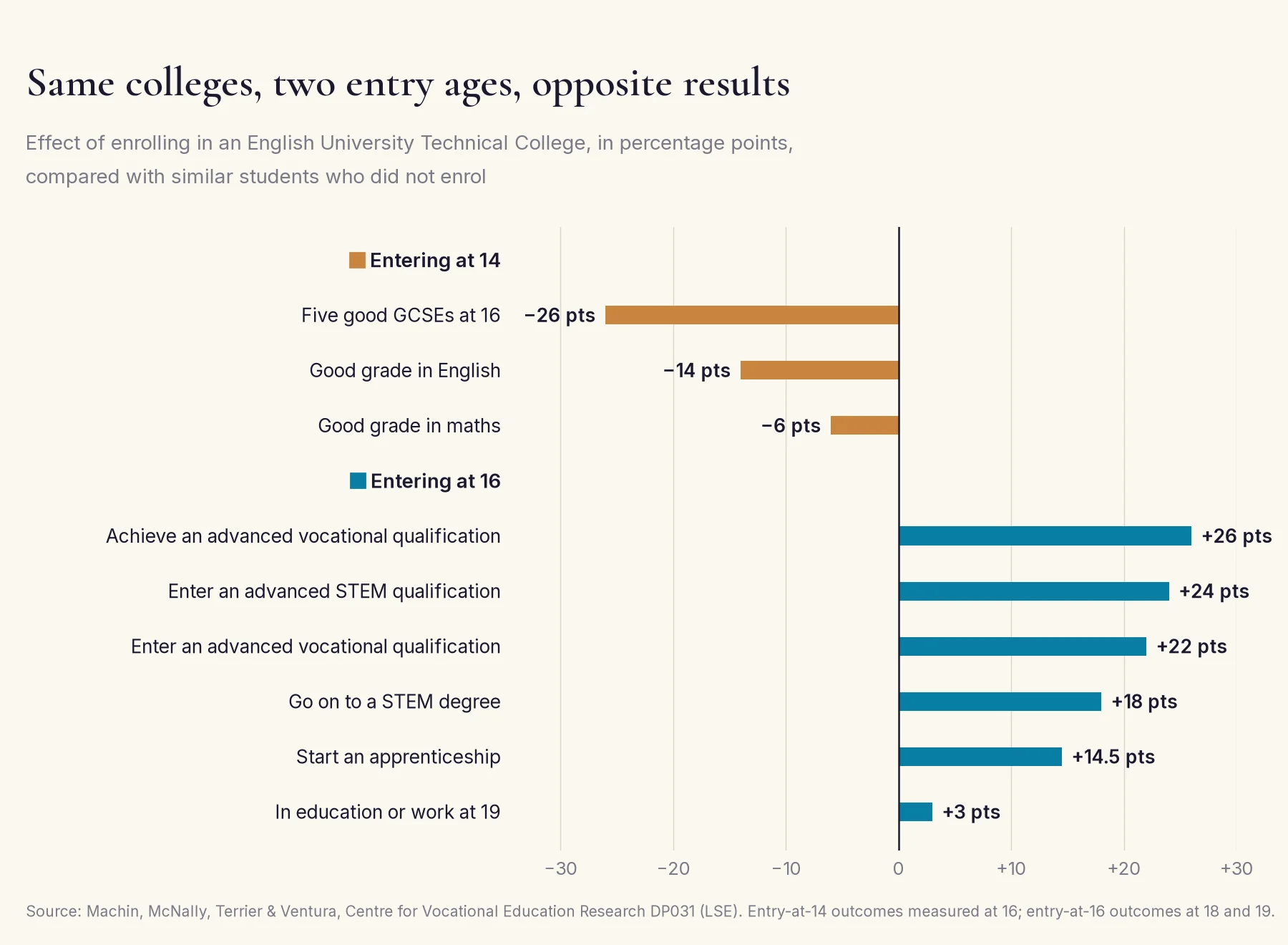
Which changes what you are preparing for. Not the role you will hold, but being able to hold it once it stops resembling the thing you chose. Going narrow early costs you information you cannot get any other way. There is no substitute for having tried a thing. The English data on technical colleges shows what the cost looks like: entering a specialised route at fourteen measurably reduces achievement at sixteen, while entering at sixteen improves it.
The cleaner test sits on the border between England and Scotland. English students apply to a single field from school and follow it. Scottish students are admitted to a broad faculty and are required to study several different fields during their first two years before specialising. Changing field during that window is sampling from a general pool. At that point it is cheap, and it is what their system is built to let them do, so that they can find out whether the first guess was wrong. That sets up a clean test of what a degree is for. If it is mainly skills for work, the English students should switch out of their field less often afterwards, because they have more to lose. If it is mainly information about what suits you, they should switch more, because they never had the chance to sample before committing. Malamud found the second.
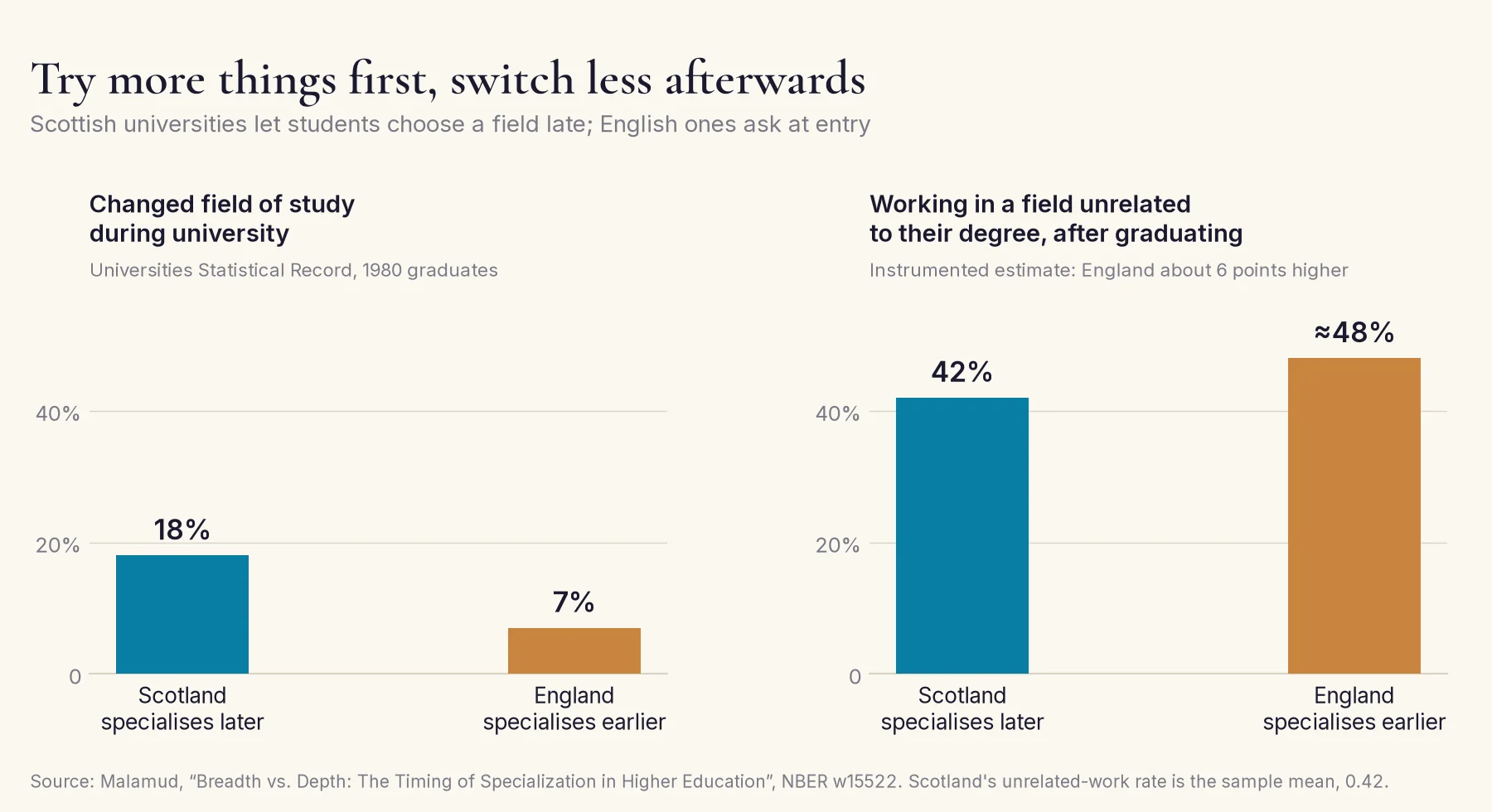
The gap after graduating is about six points, which is not large, and the size of it is not the point. What matters is where the switching happens. Scottish students do most of theirs inside university, while the guess is still cheap to change. English students do theirs after graduating, with a degree’s worth of specific skill sunk into the wrong field. The Scots also started out behind on income, having fewer specific skills, and caught up quickly. More of them graduated in subjects that had not existed in their schools at all, engineering being the obvious one, which is worth sitting with if you are fifteen and choosing from an option block.
What you are studying now is equipping you with skills that the current you cannot possibly know whether the future you will need. That is not a consolation. It is the actual argument.
What this is not
This is not to say specialists do not matter. Specialists matter enormously, and they matter most in the places where we have managed to make the environment a predictable one: where the feedback is clear, where the same lesson keeps being true, where deep practice compounds instead of misleads. Kahneman and Klein put two conditions on it: an environment regular enough to have rules, and enough practice with fast, unambiguous feedback to learn them. Medicine has built pockets of that, and it also shows how narrow they are — an anaesthetist finds out within minutes whether a judgement was right, while a radiologist can go years without learning which diagnoses they missed. Aviation built its version on purpose, through confidential incident reporting that feeds near-misses back to everyone who flies. Anywhere you can make the environment behave, depth beats breadth.
Which gives a student something usable, and it is narrower than the advice I used to give. If you can already see that the thing you are walking into behaves predictably, specialise, and do it early, and it will help you. There is nothing inherently worse about going for depth. The problem is committing to depth in a direction you have not yet been able to test, on the strength of what your friends appear to have decided.
Early narrowing made sense when a role was a stable thing to narrow into.
The same thing, one level up
I think the anxiety I see in a Year 12 is a zoomed-in version of something the adults in the building feel too.
Many teachers and school leaders I talk to worry high school has become too exam-oriented and too outcome-oriented, and that something has to bring the process back. The system feeds that, but the people also perpetuate the system, and to an extent it seems to be something we want, whether or not we notice, and whether or not it is healthy.
I would like to be an outsider noticing this but I'm not. Somebody issued my student her 82% verdict, and it was me. I did it on guidance based in years of data and experience, and I would probably do the same again, and she did the rational thing with the information I handed her. When we say students have become strategic, we are essentially describing the behaviour of people responding correctly to what we built.
What I would want to change
The thing I would ask a colleague to do differently is small and it is not a policy.
Tell students that we know excellence matters to them, and that it matters just as much to us. Then be specific about which measures of excellence hold up. The stable ones, the ones that keep paying out over a long time, are internal. Excellence is being able to stand behind what you made and the effort you put into it. It is not the score.
That is a big thing to ask of a sixteen-year-old. I am telling a teenager to value something they will not be able to see the value of for years, at an age where everyone around them appears to be looking forwards with calculation and confidence. I still do not know whether it is enough when a seventeen-year-old is standing in a hallway telling me their friends have it worked out and they do not.
The student I predicted a 6 did not stay on a 6. A predicted grade is supposed to be aspirational. If mine are right every time, something has gone wrong, because it means I have stopped betting on anyone. What her reaction showed me was that the 6 had nothing in it to reach for, and there were seven months left. Eighty-two with seven months of effort could reach eighty-seven. I took it to my head of department, who had more years of this than I did and who handed the decision back to me, and I predicted the 7.
She worked, and she finished a few points short, which I had more or less expected. I would like to say that is hindsight, but I remember thinking it at the time.
When her results came out she said to me, “I’m sorry I didn’t get the 7. I tried my best but it didn’t happen.”